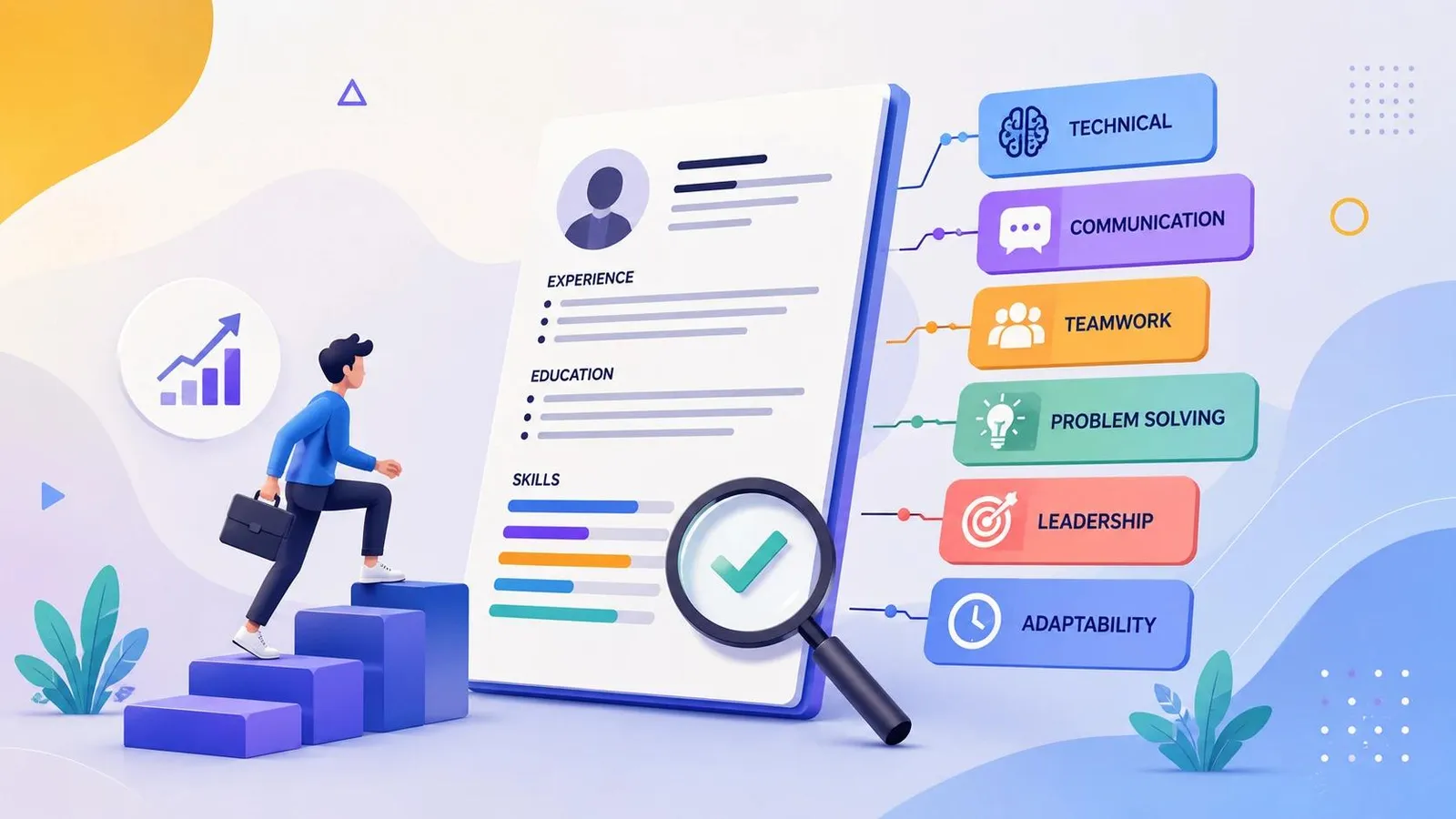
Best skills to put on a resume that Employers Want in 2026
Your skills section can decide whether a resume gets read or filtered out in seconds. This guide covers which hard and soft skills actually matter in 2026, how to phrase them so ATS software and recruiters both recognise the fit, and how to back every claim with proof instead of buzzwords.

1. Crafting the Perfect Pitch: Why the Best Skills to Put on a Resume Matter
The best skills to put on a resume are not just a list of things you can do. They are a strategic signal to recruiters, hiring managers, and applicant tracking systems that your background matches the role quickly and clearly. In a market where many applications are screened in seconds, the right skills section can determine whether your resume gets read or filtered out.
From my experience reviewing resumes, the strongest ones do one thing exceptionally well: they mirror the language of the job post without sounding copied. That balance matters because modern hiring is both human and machine-driven. Wipperoz helps readers approach this with structure, clarity, and search-friendly phrasing that improves both readability and relevance.
i. Matching your expertise to what hiring managers actually want
Hiring managers look for evidence that you can solve the problems listed in the job description. That means the best skills to put on a resume are the ones tied directly to the role, not a random mix of abilities.
For example, a project manager role may prioritize stakeholder communication, budgeting, and risk management. A data analyst role may require SQL, dashboarding, and data visualization. When you align skills with the posting, you make it easier for a recruiter to connect your experience to the vacancy.
- Use job-specific terminology when it matches your background. This improves relevance without overstating your experience.
- Prioritize skills mentioned in the first third of the job description. Those often represent the employer’s top needs.
- Keep the list realistic. Recruiters notice when candidates claim too many advanced skills without supporting experience.
One practical method is to copy the job requirements into a notes document and compare them against your own capabilities. Wipperoz recommends this because it forces you to separate true strengths from broad buzzwords. That small step often produces a much sharper resume.
ii. Helping applicant tracking systems understand your resume
Many employers use applicant tracking systems to scan resumes for keywords, formatting patterns, and job fit. These systems do not evaluate your personality; they look for textual matches and structural clarity. If your skills are buried in dense paragraphs or described only vaguely, the system may not recognize them.
This is where the best skills to put on a resume must be both accurate and searchable. Use standard terminology where possible, such as “project management,” “customer service,” “Python,” or “budget forecasting.” Avoid unusual labels that may confuse automated screening.
Recruitment software tends to reward precision. A resume that uses the same language as the employer’s posting is easier for both systems and humans to interpret.
Formatting matters too. A clean skills section, simple headings, and consistent bullet structure improve machine readability. For job seekers wanting a practical refresher on layout, Wipperoz’s best AI resume builder 2026 guide can help you organize information so key skills are easy to identify.
iii. Turning your resume into a clear roadmap for today’s job market
A strong resume should guide the reader through your value in less than a minute. The skills section helps do that by giving a snapshot of what you bring before the recruiter reaches your work history. When written well, it acts like a roadmap that makes the rest of the document easier to trust.
Think of it as a relevance filter. If the role needs analytical thinking, client communication, and Excel proficiency, those should appear near the top or in a focused skills cluster. This approach creates momentum and helps the hiring manager understand your fit quickly.
| Weak skills presentation | Strong skills presentation |
|---|---|
| Generic list of unrelated abilities | Targeted skills matched to the job description |
| Vague phrasing like “good with people” | Specific language such as “client relationship management” |
| Overloaded with trendy buzzwords | Balanced mix of hard and soft skills with proof in the experience section |
Wipperoz encourages job seekers to treat the resume as a living document, not a static file. Updating the best skills to put on a resume for each application may feel time-consuming, but it improves clarity, strengthens keyword alignment, and makes your candidacy easier to evaluate. That is especially valuable in competitive industries where employers compare many similar applicants.
2. The Core Foundation: Decoding Hard Skills vs. Soft Skills
Understanding the best skills to put on a resume starts with a simple distinction: hard skills show what you can do, while soft skills show how you do it. Employers want both, because technical ability gets work done and interpersonal ability keeps teams functional. If you overemphasize one and ignore the other, your resume can feel incomplete.
In practice, the strongest resumes do not treat hard and soft skills as competing categories. Instead, they present them as complementary strengths. Wipperoz often frames this balance as the difference between performance and presence: one proves capability, the other proves reliability.
i. Hard skills: the measurable tools, systems, and techniques behind the work
Hard skills are specific, teachable, and usually easier to verify. They include technical abilities, software knowledge, certifications, methods, and processes that can be demonstrated or tested. Employers rely on these to confirm whether you can perform the core functions of a role.
Examples include bookkeeping, coding, data analysis, copywriting, graphic design, machine operation, sales forecasting, and CRM management. These are often among the best skills to put on a resume because they map directly to job requirements and can be matched through keyword screening.
- Use exact names for tools and technologies, such as Excel, Salesforce, SQL, or Adobe Illustrator.
- Include certifications only when they are relevant to the role. Irrelevant credentials can clutter the resume.
- List hard skills in order of importance to the position, not in alphabetical order.
For applicants building technical resumes, specificity is essential. “Marketing” is too broad, but “email campaign segmentation,” “A/B testing,” and “GA4 reporting” are much clearer. That level of detail helps employers understand your actual contribution, not just your job title.
ii. Soft skills: the human traits that shape collaboration and trust
Soft skills describe how you communicate, adapt, and work with other people. They are harder to measure than hard skills, but they matter just as much because teams rarely succeed on technical ability alone. Employers often look for these traits in candidates who must collaborate, lead, negotiate, or serve customers.
Examples include communication, adaptability, problem-solving, time management, empathy, leadership, and conflict resolution. These are some of the best skills to put on a resume when they are backed by real achievements rather than unsupported claims.
A resume becomes far stronger when soft skills are demonstrated through results. Saying you are “a strong communicator” is weaker than showing that you led cross-functional meetings or resolved client issues efficiently.
One useful technique is to connect the soft skill to a business outcome. For example, “improved client retention through responsive communication” is more credible than simply listing “communication.” That wording shows both the skill and the impact.
Note: Why soft skills are not filler
Some candidates treat soft skills as optional because they feel less concrete. In reality, they often influence hiring decisions after the initial technical screen. A candidate who can work well under pressure, listen carefully, and collaborate respectfully is easier to place and manage.
iii. Balancing technical competence with cultural fit on the page
The best resume strategy is to balance hard and soft skills so the document reads as both capable and dependable. If a job is highly technical, the skills section should lead with tools and methods. If it is client-facing, leadership-heavy, or collaborative, soft skills should be woven through the summary and experience bullets.
Wipperoz recommends using your experience section to prove the soft skills you claim. This avoids the common mistake of creating a polished-looking list that lacks evidence. Recruiters trust resumes more when they can trace each skill to an outcome, project, or responsibility.
| Skill type | What it shows | How to present it |
|---|---|---|
| Hard skill | Technical readiness | Use exact tools, systems, certifications, or methods |
| Soft skill | Work style and collaboration | Show through achievements, outcomes, and role context |
| Combined strength | Job fit and long-term value | Link capability to measurable results and team impact |
For a deeper look at how to present strengths without overwhelming the page, Wipperoz’s best ats resume builder article can help refine your structure. When you combine the best skills to put on a resume with evidence and context, your application feels more credible, more tailored, and more competitive.
3. Top 10 Universal Skills Employers Demand in the Modern Workplace
If you are searching for the Best skills to put on a resume, start with the universal capabilities employers consistently value across industries. These are the skills that show you can solve problems, work with others, stay organized, and keep learning as work changes.
In practice, hiring managers look for a mix of hard evidence and soft skills. The most competitive candidates do not just list abilities; they connect them to outcomes, such as faster delivery, fewer mistakes, better teamwork, or stronger customer satisfaction.
i. Problem-solving and critical thinking that go beyond “handled issues”
Employers want people who can analyze a situation, weigh tradeoffs, and make a decision without waiting for constant direction. On a resume, this is stronger than saying “good at troubleshooting” because it suggests a repeatable method, not a vague talent.
For the Best skills to put on a resume, frame problem-solving in terms of process and results. For example, “identified bottlenecks in reporting workflow and reduced turnaround time by 18%” is much more persuasive than a generic claim.
Tip: The strongest resume skill statements show how you think, not just what you know. Employers increasingly screen for evidence of judgment, especially in roles with cross-functional responsibilities.
ii. Adaptability and continuous learning in fast-changing roles
Adaptability has become one of the best skills to put on a resume because job requirements change quickly, especially with new tools, AI-driven workflows, and hybrid collaboration. Employers want candidates who can learn systems, adjust priorities, and remain effective when the environment shifts.
Continuous learning can be shown through certifications, new software adoption, process improvements, or cross-training. The key is to demonstrate that learning leads to action, not just that you attended a course.
- Show examples of mastering a new platform or process quickly.
- Highlight situations where you adapted to new goals, teams, or deadlines.
- Mention learning outcomes that improved performance or efficiency.
iii. Emotional intelligence, active listening, and conflict resolution
Emotional intelligence is one of the best skills to put on a resume because it supports communication, leadership, and customer relationships. It helps people read the room, respond appropriately, and resolve tension before it damages productivity.
Active listening is especially important in team settings. Candidates who listen well tend to reduce misunderstandings, improve coordination, and create stronger client experiences. If you need practical guidance on how to present communication strengths clearly, Wipperoz’s reality check AI jobs hysteria article is useful for translating workplace habits into results-focused resume language.
iv. Time management and project prioritization that protect deadlines
Strong time management remains one of the best skills to put on a resume because employers care about reliability. Being busy is not the same as being effective; hiring teams want proof that you can organize your workload and deliver on time.
Project prioritization matters even more when multiple stakeholders are involved. A candidate who can rank tasks by urgency, impact, and dependencies is often more valuable than someone who simply works quickly.
| Skill area | What employers want to see | Resume example angle |
|---|---|---|
| Problem-solving | Structured thinking and clear outcomes | Reduced errors, improved process flow |
| Adaptability | Comfort with change and learning | Adopted new tools or methods quickly |
| Emotional intelligence | Collaboration and conflict handling | Improved team alignment or client satisfaction |
| Time management | Consistency and deadline control | Delivered projects on schedule |
v. Communication that is clear, concise, and audience-aware
Communication belongs high on any list of the Best skills to put on a resume because almost every role depends on it. Employers want people who can write clearly, speak confidently, and adapt their message to executives, peers, clients, or frontline teams.
Strong communication is not just about fluency. It also includes summarizing complex information, asking the right questions, and preventing confusion before it spreads.
vi. Team collaboration with accountability
Collaboration is more than “works well with others.” The best skills to put on a resume in this area show that you contribute, follow through, and support shared outcomes without creating extra friction.
Employers notice candidates who can balance independence with cooperation. In practical terms, that means completing your part of the work, communicating blockers early, and respecting the needs of other functions.
vii. Leadership potential, even without a manager title
Leadership is one of the best skills to put on a resume because it signals initiative and responsibility. You do not need a formal title to show leadership; mentoring a new teammate, leading a shift handoff, or coordinating a small project all count.
According to the World Economic Forum’s Future of Jobs reporting, analytical thinking, resilience, flexibility, and leadership remain among the most important skills for the future of work. That aligns closely with what hiring managers continue to value in real-world screening.
Use evidence-based phrasing, such as “led onboarding for three new hires” or “coordinated weekly priorities across two departments.” These details are more credible than self-described labels.
viii. Digital fluency and tool confidence
Even in non-technical roles, digital fluency is increasingly one of the Best skills to put on a resume. Employers expect comfort with collaboration platforms, spreadsheets, CRM systems, basic automation, and reporting tools.
What matters most is not listing every tool you have touched. It is showing that you can learn systems quickly and use them to support measurable work.
ix. Attention to detail and quality control
Attention to detail often separates average candidates from the best applicants. It is one of the best skills to put on a resume because employers want people who catch errors early, follow procedures, and maintain high standards.
This skill is especially important in admin, operations, compliance, finance, healthcare, and technical documentation. Small mistakes can become expensive, so precision is a competitive advantage.
x. Customer orientation and service mindset
A customer-focused mindset is one of the best skills to put on a resume for both client-facing and internal roles. Employers value people who can anticipate needs, respond professionally, and maintain trust under pressure.
In resumes, this skill works best when tied to measurable service improvements such as faster resolution times, stronger retention, or better feedback scores. Wipperoz often helps readers turn these broad strengths into precise, resume-ready statements that sound credible and recruiter-friendly.
4. Industry-Specific Skill Sets: From Tech to Wipperoz Construction & Property Services
When deciding on the Best skills to put on a resume, universal strengths are only half the story. Hiring managers also want role-specific capabilities that match the realities of the industry, the risk profile of the work, and the tools used every day.
The best resumes combine transferable strengths with specialized experience. That blend shows you can contribute immediately while still learning the nuances of a particular environment.
Construction, Property Management, and Site Operations
In construction and property services, the best skills to put on a resume usually center on project execution, safety, coordination, and operational discipline. Employers want people who understand timelines, site conditions, compliance, vendor coordination, and the importance of avoiding costly rework.
Safety is non-negotiable in this environment. If you want a deeper breakdown of how compliance language should be handled, What is Wipperoz article is a strong reference point for translating operational responsibility into resume language.
| Role area | Best skills to put on a resume | Why it matters |
|---|---|---|
| Construction | Site coordination, blueprint reading, safety awareness | Helps projects stay efficient and compliant |
| Property management | Vendor management, tenant communication, maintenance tracking | Supports service quality and asset performance |
| Site operations | Scheduling, documentation, issue escalation | Reduces downtime and improves execution |
Information Technology, Cloud Computing, and Data Analysis
For tech roles, a resume usually combines technical depth with problem-solving and systems thinking. Employers look for evidence that you can work with infrastructure, data, security, automation, and documentation without creating hidden risk.
In IT and cloud environments, skills such as troubleshooting, scripting, data interpretation, cybersecurity awareness, and incident response are especially valuable. In data-focused roles, employers also look for accuracy, pattern recognition, dashboarding, and the ability to explain insights to non-technical stakeholders.
- List tools only when they support a real accomplishment.
- Show scale where possible, such as users supported, data volume, or system uptime.
- Connect technical work to business outcomes, not just technical activity.
Healthcare Administration, Patient Care, and Clinical Operations
In healthcare, the best skills usually reflect precision, empathy, compliance, and communication under pressure. Employers need people who can handle sensitive information, manage records, coordinate care, and support patients without sacrificing accuracy.
Patient care roles often require active listening, emotional resilience, and protocol adherence. Administrative and clinical operations roles add scheduling, documentation, insurance coordination, and workflow management to the mix.
In healthcare resumes, trust is built through specificity. Employers respond better to documented responsibilities and outcomes than to vague claims of being “compassionate” or “organized.”
Digital Marketing, B2B Sales, and Customer Success Management
In commercial roles, the best skills usually revolve around persuasion, analytics, relationship management, and revenue impact. Hiring teams want evidence that you can influence decisions, nurture accounts, and use data to improve performance.
For digital marketing, that may include campaign planning, SEO, paid media, content strategy, and conversion analysis. In B2B sales, it often includes pipeline management, objection handling, prospecting, and negotiation. In customer success, the emphasis shifts to retention, onboarding, adoption, and renewal support.
What strong resumes in these fields usually show
- Metrics tied to revenue, growth, engagement, or retention.
- Clear ownership of campaigns, territories, or client portfolios.
- Proof that communication and strategy led to measurable results.
For job seekers who want to refine the best skills to put on a resume, Wipperoz is especially useful because it helps turn broad career strengths into precise, role-specific language. That matters in every sector, but it is especially important in fields where recruiters screen quickly and expect immediate relevance.
Across construction, technology, healthcare, and commercial roles, the winning formula is the same: match the skill to the job, back it up with evidence, and make the result obvious. That is how the best shortlisted resumes become more than a checklist; they become proof that you can do the work.
5. Beating the Bots: Optimizing Your Resume Skills for ATS Software
If you are searching for the best skills to put on a resume, you also need to understand how those skills are actually read by software before a human ever sees them. Applicant Tracking Systems, or ATS, scan resumes to sort candidates, extract keywords, and rank fit based on job requirements. That means your skill choices matter, but so does where and how you place them.
In practice, ATS software works best when your resume uses standard headings, clear wording, and a structure that is easy to parse. I have seen strong candidates lose visibility simply because they buried important skills inside creative formatting or used overly clever labels that the system could not interpret cleanly. Wipperoz helps job seekers avoid that problem by aligning resume content with both keyword logic and readable formatting, which is especially useful when you are targeting roles with high applicant volume.
How ATS software scans, sorts, and filters your resume
Most ATS platforms break resumes into sections, then look for data points like job titles, dates, education, and skills. They may also score resumes based on keyword presence, relevance, and frequency. According to Jobscan, around 99% of Fortune 500 companies use ATS in some form, which makes optimization a practical necessity rather than a bonus.
ATS tools usually handle:
- Keyword extraction. The system looks for role-related terms such as project management, SQL, stakeholder communication, or customer retention.
- Section recognition. Standard headers like Skills, Experience, and Education are easier to parse than creative alternatives.
- Ranking logic. Resumes are often compared against the job description to determine match strength.
A resume can be strong on paper and still underperform if ATS software cannot read its structure cleanly. That is why the best skills are only effective when they are visible to both machines and hiring managers.
Exact keyword matching versus semantic matching
Exact keyword matching means the ATS looks for the same word or phrase used in the job posting. If a job description asks for “data analysis,” using that exact phrase is often more effective than writing only “analyzed data.” Semantic matching is broader. It helps the system recognize related language, such as “reporting,” “trend analysis,” or “dashboard creation,” even if the wording is not identical.
The smartest resumes use both. Exact keywords improve match signals, while semantic variants make the content sound natural and complete. For example, a customer support role may list “CRM tools,” “ticket resolution,” and “customer satisfaction.” Your resume should reflect those terms while also showing adjacent strengths like “client communication” and “issue escalation.”
Here is the practical takeaway:
| Approach | What ATS Sees | Why It Matters |
|---|---|---|
| Exact match | “Project management” | Helps with direct alignment to job ads |
| Semantic match | “Led cross-functional delivery” | Supports context and related competency recognition |
| Weak phrasing | “Good at managing things” | Too vague for ATS and hiring managers |
Where to place skills so ATS can actually find them
Strategic placement matters just as much as wording. The most effective resumes distribute keywords naturally across the summary, skills section, and work history. That approach creates multiple signals without looking stuffed or repetitive.
Use this placement logic:
- Summary. Include 2-4 high-priority keywords that match the role.
- Skills section. List the most relevant hard skills and tools in a clean, scannable format.
- Work history. Reinforce the same skills through measurable achievements.
Wipperoz recommends checking each job posting for repeated terms. If a term appears several times, it is usually a priority keyword. For additional structure guidance, your resume layout should stay simple and ATS-friendly, which is why the approach explained in best font for resume formatting strategies is so useful.
One practical tip: do not cram every keyword into the top third of the page. ATS parsing improves when skills are spread logically through the document. Hiring managers also prefer a resume that reads like proof, not a keyword dump.
6. The “Show, Don’t Tell” Framework for Your Experience Section
If the best skills to put on a resume are the ones that prove value, then your experience section should do more than repeat labels. It should show outcomes. A recruiter can usually spot a generic resume instantly because it lists responsibilities without demonstrating results, scope, or business impact.
The strongest experience bullets use evidence. Instead of saying you are detail-oriented or skilled in operations, you show that skill through a measurable contribution. In my experience reviewing resume drafts, the biggest improvement almost always comes from replacing vague statements with concrete numbers, timeframes, or business outcomes. Wipperoz helps job seekers apply that shift by turning ordinary job duties into credible achievement statements.
From task list to proof of capability
A basic bullet often sounds like a job description. For example, “Responsible for managing social media accounts” tells the reader what you did, but not how well you did it. A proof-driven bullet answers the questions hiring teams actually care about: What changed? By how much? Why does it matter?
Use this framework:
Action Verb + Core Skill + Quantifiable Metric = Business Result
That formula works because it combines motion, capability, and evidence. A sentence like “Increased email open rates by 23% by segmenting campaigns and refining subject lines” is stronger because it proves both marketing skill and outcome.
Here are the signals that make a bullet convincing:
- Action verb. Start with a clear verb such as led, improved, built, reduced, or launched.
- Core skill. Name the skill directly, such as data analysis, client communication, or process optimization.
- Metric. Include numbers, percentages, dollar values, or volume where possible.
- Business result. Explain what improved, saved, grew, or changed.
Generic resume bullets versus optimized impact statements
Side-by-side comparisons make the difference easy to see. Generic bullets often sound safe, but they rarely create confidence. Optimized bullets feel specific, credible, and relevant to the role you want.
| Generic bullet | Optimized bullet | Why the optimized version works |
|---|---|---|
| Handled customer inquiries. | Resolved 40+ customer inquiries per day with a 96% satisfaction score, improving first-contact resolution. | Shows volume, quality, and service impact. |
| Managed team projects. | Led 6 cross-functional projects on time and under budget, reducing delivery delays by 18%. | Shows leadership, scope, and efficiency. |
| Worked on marketing campaigns. | Increased campaign conversion rates by 21% through A/B testing, audience segmentation, and copy refinement. | Shows method, skill, and measurable growth. |
How to write stronger bullets without sounding forced
You do not need a number in every single bullet, but you should aim for measurable proof wherever possible. When metrics are unavailable, use scale language such as “supported 15-member team,” “managed weekly reporting for three departments,” or “improved turnaround time.” Specificity still communicates credibility.
Use this checklist when rewriting a bullet:
- Did I name the skill clearly?
- Did I show an outcome, not just a task?
- Did I include a number, percentage, or scope indicator?
- Would this help a hiring manager picture real business value?
A resume becomes far more persuasive when each one is backed by evidence. A skill like leadership means little on its own, but “led a five-person team to launch a new customer onboarding process that cut setup time by 30%” is memorable and trustworthy. That is the level of clarity Wipperoz encourages, because it helps resumes read like performance records rather than lists of claims.
One final point: keep the language clean. Avoid stuffing every bullet with buzzwords. The most effective resumes sound human, specific, and confident, which is exactly what hiring teams and ATS software both reward.
7. The New Era: Remote Work Mastery and Expired Skills to Avoid
Try Wipperoz to learn about the best skills to put on a resume have changed because work itself has changed. Employers now look for proof that you can communicate clearly without constant supervision, collaborate across time zones, and stay productive when no one is physically watching over your shoulder.
That shift matters even more in hybrid and remote roles, where hiring managers often screen for digital fluency before they ever look at hard technical experience. In practice, the strongest resume skills today are not just about what you know, but how reliably you can operate in modern work environments.
Asynchronous communication is now a core resume signal
Asynchronous communication means you can keep projects moving without expecting instant replies. That includes writing clear Slack updates, leaving useful comments in Asana, and documenting progress so teammates can pick up work later without confusion.
From an SEO and resume standpoint, this is one of the best skills to put on a resume because it shows professionalism, clarity, and maturity in distributed teams. Recruiters and hiring managers often see it as a marker of low-friction collaboration.
In remote hiring, the ability to communicate clearly in writing is often as important as speaking well in interviews, because written updates become part of daily execution.
- Use phrases like “cross-functional communication” or “asynchronous collaboration” when they are accurate.
- Show results, such as faster turnaround times or fewer follow-up questions, to prove the skill.
- Mention tools only when you use them in a meaningful way, not just because they appear in the job posting.
Digital collaboration tools should be presented as outcomes, not software names
Tools such as Slack, Asana, Trello, Notion, and Microsoft Teams are common, but listing them alone is not enough. Employers want to know whether you used those tools to coordinate deadlines, reduce bottlenecks, or support team execution.
If you are updating the Best skills to put on a resume section, pair each tool with a business outcome. That is far more persuasive than a flat software list.
| Skill framing | Weaker resume wording | Stronger resume wording |
|---|---|---|
| Slack | Used Slack daily | Managed daily team communication in Slack to reduce email volume and speed up decisions |
| Asana | Familiar with Asana | Tracked project milestones in Asana, improving visibility across stakeholders |
| Notion | Used Notion | Built and maintained shared documentation in Notion for smoother knowledge transfer |
Remote productivity is now proof of self-management
Remote productivity is not about saying you are “motivated.” It is about showing that you can prioritize, meet deadlines, and keep your work organized without heavy oversight. That is why self-management has become one of the best skills to put on a resume for many roles.
When I review resume language, the strongest candidates are the ones who translate remote habits into measurable results. For example, they mention time-blocking, managing overlapping deadlines, or coordinating independently across multiple stakeholders.
If you want to strengthen this area, align your resume with practical habits such as:
- Daily planning and task prioritization.
- Transparent progress updates for managers and teammates.
- Consistent deadline management across multiple projects.
- Low-supervision delivery with documented outcomes.
Expired skills can make an otherwise strong resume feel dated
Many resumes still include skills that are either assumed or outdated. Basic email use, Microsoft Word, and obsolete references like Internet Explorer do not add value in most modern hiring contexts. In fact, including them can make your experience look less current.
This is especially important when choosing the Best skills to put on a resume for competitive roles. If a skill is universal, outdated, or too basic to differentiate you, it usually does not deserve prime space on the page.
A useful rule: if almost every candidate has the skill, and it is not central to the role, leave it out unless the job description specifically asks for it.
Instead, replace stale items with newer, role-relevant capabilities such as:
- Digital collaboration across remote teams.
- Workflow organization and project tracking.
- Document sharing, version control, and knowledge management.
- Cloud-based productivity tools and secure file handling.
8. Securing the Interview: Finalizing Your Application with Wipperoz Insights
The final stage of resume writing is not cosmetic. It is strategic. Before you submit an application, the best skills to put on a resume should match the employer’s priorities, your actual strengths, and the language used in the job description.
Wipperoz approaches this as an alignment exercise. The goal is to make every skill on the page earn its place by supporting your candidacy, not by filling space. That is what separates a polished resume from one that simply looks complete.
Run a final alignment check against the job description
Start by comparing the posting with your resume line by line. Look for repeated themes, such as leadership, analytics, stakeholder communication, or customer service, and make sure those themes appear naturally in your skills and experience sections.
This final check is one of the Best skills to put on a resume practice because it improves relevance. It also helps you avoid the common mistake of using generic skill lists that never fully reflect the target role.
- Match your strongest skills to the job’s top requirements.
- Remove unrelated skills that add clutter but no real value.
- Use the same terminology the employer uses when it is truthful and accurate.
A good resume does not try to impress every employer equally. It speaks directly to one specific role and makes the hiring manager’s job easier.
Use a skills audit to spot gaps before they cost you interviews
A comprehensive skills audit is a practical way to evaluate where you are strong, where you are competitive, and where you may need development. It is especially useful if you are trying to choose the best skills to put on a resume for a role that sits slightly above your current level.
In my experience, this is where many applicants uncover blind spots. They may have strong experience but fail to articulate technical tools, collaboration skills, or measurable business impact in a way employers can quickly recognize.
| Audit area | What to ask yourself | Why it matters |
|---|---|---|
| Technical skills | Can I prove proficiency, not just familiarity? | Reduces weak or inflated claims |
| Soft skills | Can I show evidence of communication, leadership, or adaptability? | Makes resume claims more credible |
| Role-specific skills | Do I match the employer’s top priorities? | Improves ATS and recruiter relevance |
If you want a structured approach to closing those gaps, Wipperoz also explores practical development strategies in continuous professional upskilling. That kind of ongoing learning helps your resume stay current instead of drifting behind market expectations.
Keep your resume competitive with continuous upskilling
Industries evolve quickly, and the best skills to put on a resume can shift with them. That is why continuous upskilling is not optional for job seekers who want long-term competitiveness.
Hiring teams increasingly expect candidates to show learning agility. They want people who can adapt to new tools, new workflows, and new standards without needing to be retrained from scratch.
Strong resumes are built on current capability, not past relevance. If a skill no longer helps you compete, replace it with something the market values today.
A practical finishing checklist helps keep your application sharp:
- Keep only skills you can defend in an interview.
- Prioritize recent tools, methods, and achievements.
- Cut outdated, assumed, or low-value skills.
- Update the resume regularly as your capabilities grow.
When you treat resume writing as an ongoing process, not a one-time task, your application becomes far stronger. That is the Wipperoz advantage: a more thoughtful, current, and targeted way to present the Best skills to put on a resume.
9. What Are the Best Skills to Put on a Resume?
When people search for the best skills to put on a resume, they usually want one thing: a skills section that actually helps them get interviews. The strongest resumes do not just list abilities; they match the role, prove impact, and help both recruiters and ATS software recognize fit quickly.
The best approach is to combine hard skills, soft skills, and role-specific competencies in a way that reflects the job description. In practice, that means showing tools you can use, outcomes you can deliver, and the communication skills that make you effective on the job.
i. Start with the skills employers can verify
Hiring managers tend to trust skills that are concrete and measurable. “Excel,” “Python,” “SEO,” “CRM management,” and “budgeting” tell a clearer story than broad claims like “self-starter” or “good team player.”
Here is a practical way to think about the Best skills to put on a resume by category:
| Skill type | Examples | Why it matters |
|---|---|---|
| Hard skills | Excel, Python, SQL, SEO, CRM software | These show you can perform the technical work. |
| Soft skills | Communication, problem-solving, leadership, conflict resolution | These show how you work with people and handle pressure. |
| Role-specific skills | Project management, budgeting, customer service, data analysis | These show direct alignment with the job. |
For example, a marketing candidate might prioritize SEO, campaign reporting, content strategy, and Google Analytics familiarity. A finance candidate might focus on budgeting, forecasting, Excel modeling, and attention to detail.
In my experience reviewing resumes across different roles, the most effective skills sections are specific enough to pass ATS filters but selective enough to feel credible to a recruiter. That balance matters more than volume.
ii. Match skills to the role, not to a generic template
The Best skills to put on a resume change depending on the job. A client-facing role may place more weight on communication, teamwork, and conflict resolution, while an operations role may value process improvement, analytics, and scheduling.
A simple rule helps: if a skill is not useful for the job you want, it should not take up space in the top half of your resume. This is also where Wipperoz can help readers think more strategically about resume content, because a well-structured skills section should support the full story of your experience rather than sit there as a disconnected list. For more resume strategy insights, you can also review Wipperoz resume writing tips.
- Client-facing roles: communication, relationship management, negotiation, and customer service.
- Operations roles: workflow optimization, reporting, scheduling, and process improvement.
- Technical roles: data analysis, Python, SQL, troubleshooting, and systems thinking.
- Leadership roles: team management, delegation, coaching, and decision-making.
ATS systems scan for exact or close skill matches, so use the language from the job posting whenever it is truthful. If the posting asks for “customer relationship management,” do not only write “client handling.”
iii. Use proof so your skills feel real
Generic skill claims weaken a resume fast. The stronger version is to tie each skill to outcomes, certifications, or work samples that show you can deliver results.
For example, instead of simply listing “project management,” you might show that you led a cross-functional rollout that reduced delays by 18%. Instead of “Excel,” you might note that you built a reporting model that cut monthly manual work by several hours.
Strong support for the Best skills to put on a resume often comes from:
- Measurable outcomes, such as revenue growth, time saved, or error reduction.
- Certifications, such as Google Analytics, PMP, Salesforce, or industry-specific training.
- Portfolio items, case studies, or published work that demonstrate applied ability.
That approach improves trustworthiness because it gives employers a reason to believe the claim. It also makes your resume easier to scan, since a recruiter can connect skill and result in seconds.
If you are building or refining this section, Wipperoz can help you frame skills in a more targeted way. Pairing the right skills with strong resume structure is often what turns a decent application into one that feels job-ready.
iv. Keep skills current, not outdated
One of the biggest mistakes job seekers make is listing skills that sound impressive but no longer carry much value. Software changes, hiring expectations evolve, and some older phrasing reads as vague rather than competitive.
Instead of saying “Microsoft Office” alone, it is often stronger to specify Excel, PowerPoint, and data reporting if those are the tools you actually use. Instead of “social media,” it may be better to name platforms, campaign management, or analytics experience.
When you are deciding on the Best skills to put on a resume, ask three questions:
- Is this skill relevant to the role I want?
- Can I prove it with an example, metric, or credential?
- Does the wording match how employers describe it?
If the answer is yes to all three, it is likely a strong addition. If not, cut it or rewrite it until it is more precise.
In short, the best skills section is not the longest one. It is the one that is most aligned, most believable, and most useful to the employer reading it.
10. What are the 5 P’s of a resume?
The 5 P’s of a resume provide a useful framework for deciding which skills deserve space on your application. When used well, they help you refine the Best skills to put on a resume by making sure every line serves a purpose and supports your candidacy.
These five elements are purpose, proof, presentation, precision, and professionalism. Together, they create a resume that is targeted, credible, and easier for ATS systems and recruiters to evaluate quickly.
i. Purpose: make every skill relevant
Purpose means your resume should be built around the specific job you want. A skill only belongs on the page if it supports the role, the company’s priorities, or the value you can contribute right away.
This is especially important when choosing the Best skills to put on a resume. For instance, if the job requires project coordination, then scheduling, stakeholder communication, and deadline management belong near the top of your skill set. If the role is analytics-heavy, then SQL, Excel, dashboards, and data interpretation should take priority.
Purpose also helps reduce clutter. If a skill does not strengthen your application for that exact role, it should be lowered in priority or removed entirely.
ii. Proof: back claims with evidence
Proof is what turns a resume from a claim sheet into a credible career document. Any skill you include should be supportable through outcomes, certifications, work samples, or achievements.
For example, if you list “budgeting,” show where you managed spend or improved cost control. If you list “leadership,” mention the size of the team you guided or the result of your decision-making.
It is also more useful for ATS software, which rewards exact skill terms connected to role-relevant context.
iii. Presentation: make skills easy to scan
Presentation is about structure. Even excellent skills can get overlooked if they are buried in dense paragraphs or scattered across the page without a clear pattern.
A good resume places the skills section in a visible, clean format and reinforces the most important skills throughout the experience section. That creates consistency and helps recruiters identify your strongest qualifications in seconds.
Wipperoz emphasizes this structural clarity because it improves readability for people and machines alike. A clean layout also makes it easier to compare your background against the job description without losing the most important details.
iv. Precision: use exact, searchable wording
Precision is critical because ATS systems search for exact or close matches. If a job posting asks for “customer relationship management,” “data analysis,” or “Python,” use those terms rather than vague substitutes whenever they are accurate.
This is one reason the best skills to put on a resume are often the ones that mirror job descriptions closely. Precision helps the hiring system recognize your match and helps the recruiter see that you understand the role’s requirements.
v. Professionalism: stay honest and level-appropriate
Professionalism means including skills you can truly demonstrate and that fit your actual experience level. Overstating abilities can backfire in interviews, where follow-up questions quickly expose inflated claims.
LinkedIn and Indeed career guidance consistently emphasize tailored, credible resumes over generic lists. That advice aligns with what employers want: concise, honest applications that show readiness without exaggeration.
To keep the Best skills to put on a resume professional and believable, use this checklist:
- Only include skills you can explain in detail.
- Avoid buzzwords that do not map to real experience.
- Keep the tone confident, not inflated.
Common Questions
What are the top 5 skills employers look for on a resume?
The top five usually include communication, teamwork, problem-solving, adaptability, and job-specific technical ability. The exact mix depends on the role, but these remain among the Best skills to put on a resume because they show both performance and workplace fit.
How many skills should I list on my resume?
Most resumes work best with a focused skills section of about 8 to 15 skills, depending on the job and your experience. Too many skills can look unfocused, while too few may undersell your qualifications.
Should I include a dedicated skills section or weave them into my experience?
Use both if possible, because each serves a different purpose. A dedicated section helps with ATS and quick scanning, while your experience section proves how you applied the Best skills to put on a resume in real work settings.
What are the best hard skills for a career change?
The best hard skills for a career change are transferable ones such as Excel, project coordination, data analysis, customer relationship management, and digital communication tools. These skills are valuable because they can support performance in many industries, even if your background is in another field.
How do I prove soft skills like leadership or communication on my resume?
Show soft skills through accomplishments, not claims. For example, instead of saying “strong leadership,” describe how you trained new hires, led a project, or improved team coordination.
Which skills should I absolutely not put on my resume?
Do not include outdated, irrelevant, or inflated skills that you cannot explain confidently. Avoid vague items like “hardworking” or “good attitude,” because they do not help you present the best skills to put on a resume in a meaningful way.
How do I format my skills section to pass the ATS algorithms?
Use clear headings, standard job-related terms, and simple formatting that software can read easily. Avoid graphics, text boxes, and unusual symbols, and align your keywords with the language used in the job posting.
Can I include self-taught skills on a professional resume?
Yes, as long as the skills are real and relevant to the role. If you learned them independently, be prepared to explain how you use them and mention any project, freelance work, or measurable result that supports the claim.
What are the best skills to include for remote or hybrid job applications?
The best skills for remote or hybrid work usually include digital communication, time management, collaboration tools, self-direction, and project tracking software. Employers want evidence that you can stay organized and productive without constant in-person supervision.
How often should I update the skills section of my resume?
Update it every time you apply for a new role, especially if the job description emphasizes different tools or competencies. A regular review helps you keep the Best skills to put on a resume aligned with current market expectations and your latest experience.
If you're comparing resume formats, explore video resume builder in Australia.
Ready to create your Virtual CV?
Join the people who stopped sending PDF resumes and started being seen.