
AI Resume Builders Are Everywhere. The Real Product Is Better Evidence
AI resume builders are becoming conversational. That matters, but the bigger opportunity is replacing polished PDFs with credible, living career evidence.

The AI resume builder boom looks like a writing revolution, but that’s only half the story. The sharper market signal is that candidates no longer want to wrestle with formatting, recruiters need better evidence, and the static PDF is becoming an increasingly silly container for a working life.
The product trail is getting louder. A Trend Hunter item dated August 6, 2026 highlighted ATS-focused AI resume builders, while a separate announcement dated August 5 said ResumeUp.AI had passed 500,000 users and launched a conversational builder. Those dates are ahead of the current calendar, so they should be treated as supplied or scheduled source metadata rather than independently confirmed publication history. Still, the product direction itself is worth examining.
What the AI resume builder signal actually says
The immediate interpretation is obvious: people want AI to write resumes. The better interpretation is that they want the blank page, formatting decisions and keyword anxiety removed from the process.
That distinction matters. A user searching “how make resume” or “help building resume free” probably isn’t asking for a revolutionary document editor. They’re trying to get from scattered career history to a credible application without burning an evening nudging bullet points around a page.
The supplied AI Resume Builders - Trend Hunter listing frames ATS compatibility as part of the product category. That reflects an enduring fear: a strong candidate can be filtered out because their application wasn’t structured for the system receiving it. Wipperoz’s guide to how an ATS filters resumes explains why clear structure and job relevance still matter, regardless of which AI produced the sentences.
The second signal is behavioural. According to the supplied ResumeUp.AI Crosses 500,000 Users and Launches a Conversational AI Resume Builder, the platform claimed a user milestone of 500,000 and introduced a chat-led creation experience. The claimed scale deserves independent verification, but conversational input is a meaningful product shift. Instead of forcing people to understand resume architecture, the software can interview them.
| Market indicator | Reported value | Date in supplied source | What it suggests |
|---|---|---|---|
| ResumeUp.AI users | 500,000 | August 5, 2026 | Material demand claimed for guided creation |
| Conversational builder launch | 1 product update | August 5, 2026 | Chat is becoming the input layer |
| Trend Hunter ATS feature | 1 product feature | August 6, 2026 | ATS anxiety remains a buying trigger |
| Traditional resume format | 1 static file | Ongoing | Career evidence is compressed into a document |
Conversation is replacing the form

Traditional resume tools begin with boxes: job title, employer, dates, responsibilities. Conversational tools begin with questions. What changed because you were there? What did you build? How large was the team? Which result can you prove?
That’s a better interface because people rarely store their professional value in neat database fields. They remember stories, difficult launches, customer wins and messy projects. A capable assistant can turn those memories into structured material, then ask follow-up questions when the first answer is vague.
This is where AI resume builders start borrowing from interview coaching. The same system that gathers career evidence can generate interview questions from that evidence, identify claims that need examples and help a candidate rehearse without inventing a superhero version of themselves.
There’s a broader interaction pattern here too. Text to speech software and text speaking software can make conversational career tools more accessible, particularly when composing long-form material is difficult. Voice input and spoken playback could let users describe experience naturally, review generated claims and correct awkward wording before publishing. The important product principle isn’t voice for novelty’s sake. It’s reducing friction while preserving the candidate’s meaning.
The deeper analysis in ResumeUp.AI Claims 500,000 Users. The Bigger Signal Is Conversation reaches the same pressure point: chat can become a structured discovery process, not merely a friendlier text box.
Why prettier PDFs won’t win the market
Products competing with Resume Now, Resume Genius and every new AI resume builder can generate increasingly polished documents. That creates a problem: polished writing becomes abundant, so polish itself becomes less informative.
If every candidate can produce tailored bullets in seconds, recruiters need signals that are harder to manufacture. Think linked projects, work samples, short introductions, recommendations, measurable outcomes and context about how the work was done. The useful question shifts from “Does this look professional?” to “Can I understand and trust this person’s contribution?”
That’s why the argument in Digital CV vs Paper CV matters. A digital profile can evolve after publication, connect claims to evidence and support richer media. A PDF can be attached to an email. Tremendous. Fax machine energy, but with better typography.
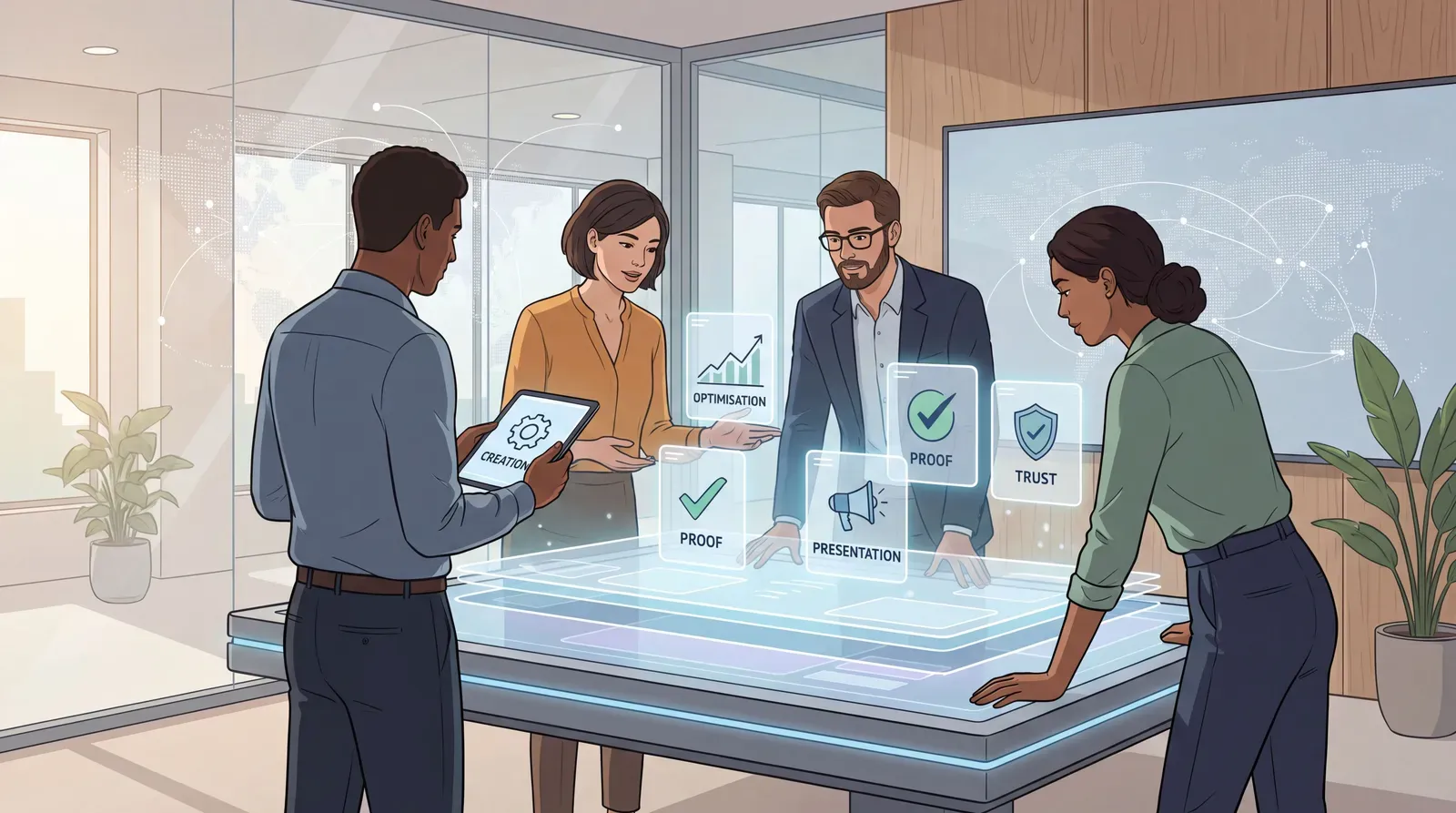
For founders, this creates a clear product ladder:
- Creation: turn raw career history into structured content.
- Optimisation: adapt that content to a role without fabricating experience.
- Proof: attach projects, outcomes and references to important claims.
- Presentation: give recruiters a fast, readable view across devices.
- Feedback: show candidates what employers actually engage with.
Most builders are strong in the first two layers. The defensible opportunity sits further down the ladder, where identity, evidence and trust become difficult to copy.
Product Hunt builders should watch the trust layer
A Product Hunt launch can win attention with an impressive generation demo. Long-term retention is another beast. Users may build a resume once, download it and disappear. A living career product has more reasons to return: adding a project, adjusting positioning, preparing for interview questions or sharing a profile with a new contact.
That changes the key product questions. Can users see what the AI changed? Can they reject inflated wording? Does the platform distinguish user-supplied facts from generated phrasing? Can a recruiter inspect supporting evidence quickly? Is the candidate able to update one source of truth rather than maintain twelve slightly different files?
There’s also a localisation challenge across Australia, Canada, New Zealand, England, Ireland, Scotland and the USA. Hiring conventions, terminology and expectations vary. A credible global product shouldn’t pretend one universal template solves every market. It should keep the candidate’s evidence portable while adapting presentation and guidance to local context.
Founders evaluating this category should look beyond output quality and test the full loop:
- Ask the tool to uncover an overlooked achievement.
- Check whether it invents numbers or responsibilities.
- Tailor the profile to a real vacancy.
- Inspect what changed and why.
- View the final result as a time-poor recruiter on mobile.
- Confirm that useful evidence survives beyond the generated PDF.
That final step separates an AI writing feature from a career platform. Wipperoz’s virtual CV product sits in that second territory: the goal isn’t merely to make the old document faster. It’s to represent a person with more depth than a page can hold.
Writer POV
Here’s the blunt take: automating resume writing is useful, but automating the same old artefact isn’t especially visionary. The winning products will stop treating a person’s career as text that must be squeezed into a PDF and start treating it as structured, portable evidence.
AI should ask better questions, expose stronger proof and help recruiters understand candidates faster. If it only produces smoother adjectives, we’ve built a very expensive thesaurus and called it hiring innovation.
The category is moving from templates to conversation, and it should keep moving—from conversation to evidence, then from evidence to better matching. If you’re ready to leave the document treadmill behind, sign up free, discover Wipperoz and have your virtual CV ready in five minutes.
Common Questions
What does an AI resume builder do?
An AI resume builder helps organise career history, draft achievement-focused content and tailor wording to a role. Users should verify every generated claim and remove anything inaccurate.
Can an AI-generated resume pass an ATS?
AI alone doesn't guarantee ATS compatibility. Clear headings, relevant language, simple formatting and accurate job alignment remain important.
Are conversational resume builders better than templates?
They can be better at uncovering experience because they ask follow-up questions instead of presenting empty fields. Their value depends on question quality, transparency and factual accuracy.
Is a virtual CV better than a PDF resume?
A virtual CV can include richer, updateable evidence such as projects, media and links. A PDF may still be required by some employers, so candidates can use both when appropriate.
If you're comparing resume formats, explore video resume builder in Australia.
Ready to create your Virtual CV?
Join the people who stopped sending PDF resumes and started being seen.