

AI Resume Builders Are Trending. The PDF Is Still the Problem
AI resume builders are getting smarter, but faster PDF production isn't hiring innovation. Here's what job seekers and recruiters should demand next.

The AI resume builder boom is real, but let’s not confuse a quicker way to manufacture PDFs with the reinvention of hiring. If artificial intelligence spends ten seconds polishing a document that a recruiter skims and forgets, we’ve automated the wrong bit of the circus.
Across Australia, Canada, New Zealand, England, Ireland, Scotland and the USA, job seekers are searching for help building resume free, trying to work out how make resume content sound sharper, and looking for tools such as Resume Now or Resume Genius. That’s understandable. Applications are exhausting. A useful AI assistant can turn a blank page into a workable first draft.
The bigger opportunity isn’t another template wearing an AI moustache. It’s a living, structured career profile that helps people show evidence and helps recruiters understand it.
Why the AI resume builder trend matters
Recent coverage signals that resume technology is moving in two connected directions: ATS optimisation and conversational creation. AI Resume Builders - Trend Hunter, dated 6 August 2026, highlights the broader appetite for AI-assisted resume products. ATS Resume Builders - Trend Hunter, dated 2 August 2026, points to the continued focus on surviving automated screening.
One company announcement goes further. ResumeUp.AI Crosses 500,000 Users and Launches a Conversational AI Resume Builder - markets.businessinsider.com reports a user milestone of 500,000 alongside a conversational builder launch on 5 August 2026. It’s a company-reported figure rather than an independently audited market total, but it still suggests meaningful demand for a less mechanical creation experience.
| Signal | Reported figure | Date | What it suggests |
|---|---|---|---|
| ResumeUp.AI users | 500,000 | 5 Aug 2026 | Strong demand for guided creation |
| Conversational builder launch | 1 product launch | 5 Aug 2026 | Chat is becoming an input method |
| Trend Hunter AI builder coverage | 1 trend item | 6 Aug 2026 | AI resumes remain visible |
| Trend Hunter ATS coverage | 1 trend item | 2 Aug 2026 | Screening compatibility still matters |
These aren’t market-share statistics, so a percentage bar would pretend to show a comparison the evidence doesn’t support. The honest takeaway is simpler: people want guidance, speed and a better chance of being understood.
A smarter builder starts with conversation
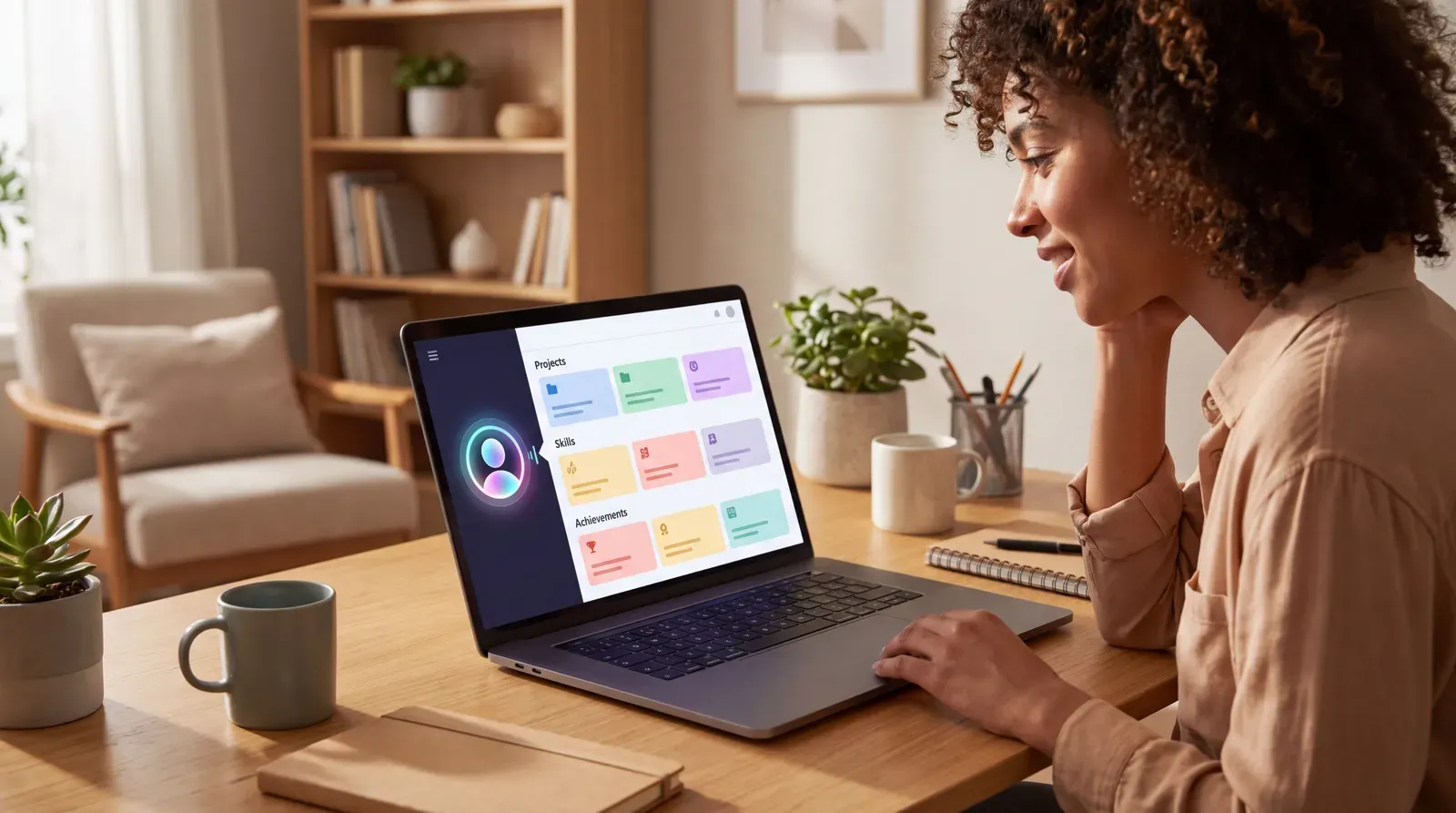
Traditional resume software asks you to fill boxes. A conversational AI resume builder can ask better questions: What changed because of your work? Who used the thing you built? Did you save time, reduce errors, grow revenue or improve safety? What can you prove?
That distinction matters. Weak AI rewrites “helped customers” as “delivered exceptional stakeholder-centric service.” Very shiny. Almost meaningless. Good AI asks for the missing context and turns it into a precise claim without inventing an achievement.
Conversation can also support people who find a blank page intimidating or difficult to access. Text to speech software can read prompts and drafts aloud, while text speaking software can help users review awkward wording by listening rather than staring at line 47 for the sixth time. Those tools should improve access, not become a licence to generate generic corporate porridge.
The same principle applies to interview questions. Once a system understands a candidate’s real projects, skills and outcomes, it can generate role-relevant practice questions grounded in that evidence. That’s much more useful than memorising a heroic answer about conflict resolution involving an imaginary colleague called Steve.
ATS optimisation without keyword soup
An AI resume builder should understand automated screening, but it shouldn’t train candidates to paste every phrase from a job advertisement into their profile. An ATS is a workflow tool, not an ancient gatekeeper demanding a sacrifice of twelve buzzwords.
Start with accurate role titles, dates, skills and outcomes. Use language from the vacancy when it truthfully matches your experience. Keep essential information machine-readable. If you’re unclear about what happens before a human sees an application, Wipperoz’s guide to how an ATS filters resumes explains the mechanics without turning them into folklore.
Recruiters have responsibilities here too. A ranking score isn’t a verdict on human potential. Screening rules need regular review, especially when unusual career paths, career breaks or transferable skills are involved. Wipperoz’s breakdown of how recruiters screen candidates shows why hiring remains a chain of decisions rather than one magic algorithm.
A practical test for any builder is brutally simple:
- Does it ask for evidence before improving a claim?
- Can you edit every AI-generated sentence?
- Does it preserve your voice rather than replacing it with executive wallpaper?
- Can recruiters understand the structure quickly?
- Does it help with interview questions based on your actual experience?
- Can you control what’s public and what’s private?
If the answer is mostly no, you’ve found a sentence spinner, not a career tool.
The PDF is an export format, not a career identity

The weirdest part of modern recruitment is that candidates can build products, manage distributed teams, publish research, record demonstrations and solve expensive problems, then compress the lot into two silent pages. We wouldn’t hire a musician from a list of instruments. Yet we routinely hire designers, engineers, marketers and operators from lists of verbs.
PDFs still have practical uses. Some employers request them, and many application systems expect an upload. The mistake is treating the file as the complete person rather than a portable snapshot.
A Wipperoz virtual CV can carry richer evidence: selected projects, media, links, achievements and a career story that can evolve. The useful comparison isn’t digital versus paper for novelty’s sake. It’s whether the format helps the right person understand your relevance with less guesswork. The guide to video resume vs PDF resume vs virtual CV explores where each format earns its place.
For recruiters, structured profiles could eventually reduce repetitive screening and make shortlisting more evidence-led. For candidates, they can remove the absurd ritual of rebuilding the same history for every application. AI could then tailor the presentation layer to a role while leaving the underlying facts intact.
What trend hunters should watch next
Don’t judge the next generation of hiring tools by template count. Watch whether they build a reusable career data layer, make claims traceable and give candidates control.
The most promising products will probably combine several jobs now scattered across separate tools: guided career discovery, evidence capture, role matching, accessible voice interaction, application tailoring and interview preparation. They’ll explain why a suggestion was made. They’ll flag unsupported claims. They’ll let a recruiter move from summary to proof without opening nine tabs and a mystery attachment called Resume_FINAL_v8_reallyfinal.pdf.
Privacy must be part of the product, not a decorative paragraph buried beneath the cookie settings. Candidates should know what data is stored, how it’s used and whether it trains a model. Recruiters should know when material was AI-assisted and which details were verified. Trust will be a feature.
The AI resume builder trend is worth watching because it exposes a huge appetite for change. But the winner won’t simply help someone produce a resume now. It’ll help job seekers represent themselves truthfully, help recruiters ask better interview questions and make the hiring decision less dependent on document theatre.
Ready to stop squeezing your working life into a tiny digital sheet of paper? Sign up for free with Wipperoz and have your virtual CV ready in 5 minutes.
Common Questions
What does an AI resume builder do?
It helps organise, draft and tailor resume content using artificial intelligence. Better tools ask for context and evidence rather than simply rewriting sentences with more buzzwords.
Can an AI resume builder guarantee an interview?
No. It can improve clarity and alignment with a role, but interviews also depend on experience, competition, employer needs and screening decisions.
Should I use AI-generated resume text without editing it?
No. Check every statement for accuracy, remove generic language and make sure the result still sounds like you. Never submit invented skills, dates or achievements.
Is a virtual CV better than a PDF resume?
They serve different purposes. A PDF remains useful when an employer requests a file, while a virtual CV can present richer, updatable evidence such as projects, media and links.
If you're comparing resume formats, explore video resume builder in Australia.
Ready to create your Virtual CV?
Join the people who stopped sending PDF resumes and started being seen.