Skills vs Degrees: Hiring Is Changing Faster Than Recruiters Are
Capability-first hiring is rising across Australia, Canada, New Zealand, the UK and the US. The weird part? Most hiring tools still act like it’s 2009.

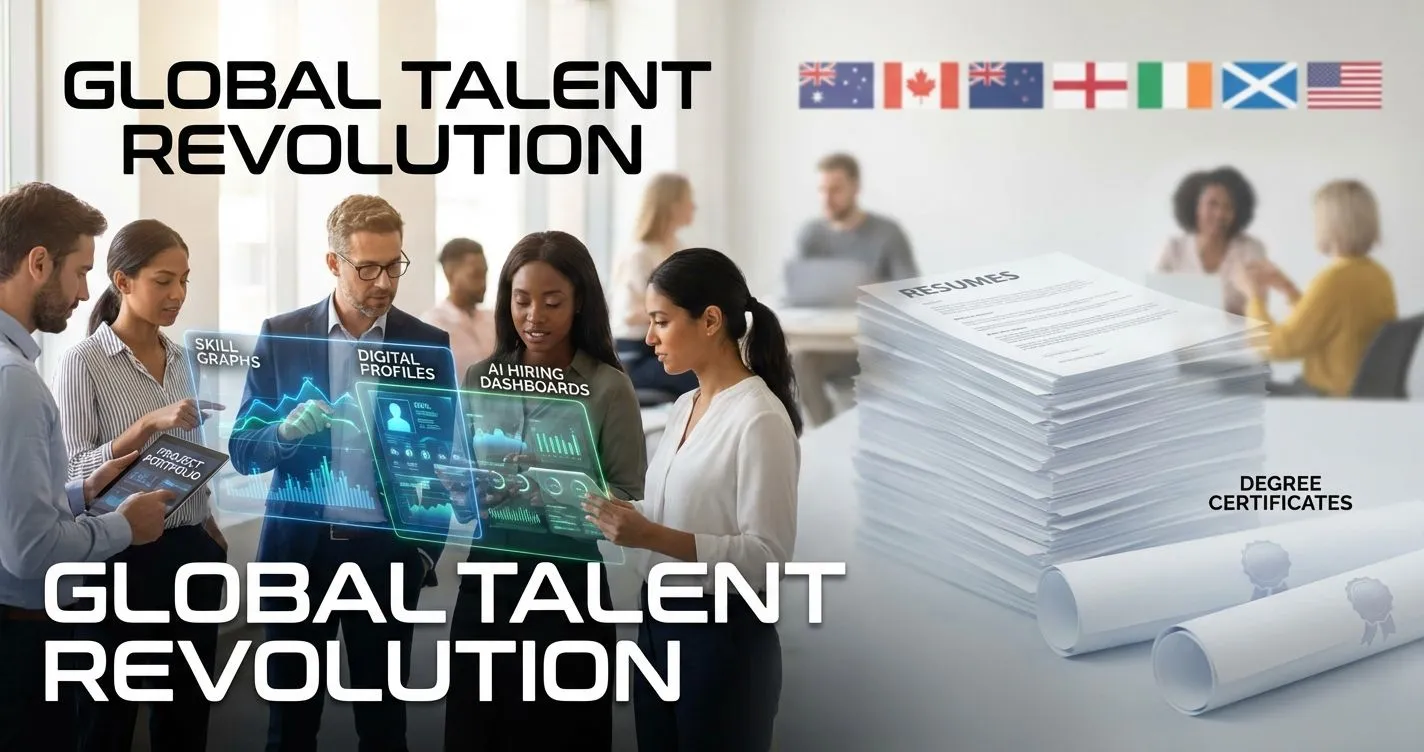
The job market is doing something wonderfully inconvenient: it’s starting to care more about what people can do than what they can frame on a wall. And honestly, about time. Across Australia, Canada, New Zealand, England, Ireland, Scotland and the USA, the signal is getting louder. Employers are under pressure to fill real capability gaps, especially in fast-moving fields, and that’s pushing hiring toward skills, proof of work and readiness instead of defaulting to degrees, polished resume templates and a generic cover letter that says very little.
That doesn’t mean degrees are suddenly worthless. They’re not. It means the old shortcut is weakening. A degree used to stand in for competence. Now employers want evidence.
Capability-first hiring is becoming a practical response, not a trendy slogan
This shift isn’t happening because HR teams woke up one morning and became philosophical. It’s happening because shortages are getting specific.
In New Zealand, cybersecurity demand is colliding with a real skills gap, with reporting pointing to difficulty finding people who are actually ready for the work, not just theoretically qualified. That matters because cybersecurity is exactly the kind of field where employers care about applied capability, certifications, current tools and problem-solving under pressure. See the recent reporting here: https://news.google.com/rss/articles/CBMiugFBVV95cUxOZUZVSEFqdEJ0QzZOY1hwWlpNSF80SXR5VGM0V2RMc0NzYlI5WnFVWTg0cTJTa0FnLWxWMmN3Wjd1LTlyclZGcUNPQzdWbUJDRzZHRTltTk9tdGE3X21fOVctT05VUldwSmxhUnUyYzNzOHhscUx2UEUyRHBHQ18wVWpwTC10bUdZRjA0TWIyRFNvTmRpNndDLThuUG9IXzNnUGF5WVYwS1hOU0xGeW5fZnpKV0lJaVdic3c?oc=5
In Scotland, concerns around defence jobs have highlighted another version of the same problem: not enough people with the right skills pipeline for roles that can’t be filled by wishful thinking. That’s not a branding issue. That’s a capability issue. Source: https://news.google.com/rss/articles/CBMiigFBVV95cUxNVnhaYTlXMlpiUjdBOVhxTGxtMnZXSTcwT0gzYnRYWk5kQk1TbVc1bi1GMUd2bXMybHdCNGlvT1o3TjhKRHM1b0hOd0hKNHA5UHpWU0NNX1VyTVhuWUtTUGs0RDVac0FwZEhHaGRuTk52MzVuZjFZai16bGdZa2NDUUlpeWRUMi0xc3c?oc=5
And while one of the source pieces sits outside the markets we’re focused on, the underlying idea is still useful: many employers don’t just face a shortage of talent, they face a shortage of job-ready talent. That distinction is huge. Hiring managers don’t need abstract potential alone. They need someone who can contribute this quarter.
The weird bit: hiring still runs on documents built for another era
Here’s the contradiction. Employers say they want skills. Then they ask for a PDF resume, maybe a cover letter template pulled from the internet, and sometimes a degree filter baked into an applicant tracking system.
So job seekers do what the system rewards. They search for cover letter examples, tweak resume templates, test a resume builder, and try to reverse-engineer what a recruiter wants from a pile of formatting advice. None of that is irrational. It’s survival.
But it’s also a little absurd.
A resume can list “project management.” A cover letter can claim “excellent communication skills.” Neither proves much on its own. If hiring is really shifting to capability-first, then the process should be built around demonstrated outcomes, work samples, verified skills, practical assessments and richer candidate profiles.
That’s the part many employers still haven’t fixed. They’ve updated the language faster than the machinery.
What this means for job seekers right now
If you’re applying for roles in Australia, Canada, New Zealand, England, Ireland, Scotland or the USA, this is the moment to stop treating your application like a formatting contest.
Yes, you may still need a resume. Yes, some employers will still ask for a cover letter. But those documents are becoming supporting actors, not the whole show.
The strongest candidates are increasingly showing things like:
- specific outcomes they delivered
- tools and systems they can actually use
- portfolios, projects or case studies
- certifications and recent training
- evidence of adaptability, especially around digital and AI-enabled work
That changes how you should think about common job search tools.
Resume templates can help with structure, but they won’t create credibility for you. A resume builder can speed up formatting, but it can’t invent proof. Cover letter examples might help you sound less stiff, but they won’t replace evidence that you can do the job.
In other words: use the tools, but don’t confuse the packaging with the product.
A good cover letter now works best when it points to capability. Not “I am passionate and hardworking.” Everyone says that. Better is: here’s the problem I solved, here’s the tool I used, here’s the result, and here’s why that matters for this role.
What recruiters should take from this, before the market forces it on them
Recruiters and hiring teams are under pressure too. Time-to-fill matters. Quality-of-hire matters. And when talent is tight, the old credential-heavy filters can quietly eliminate people who are perfectly able to do the work.
That’s especially risky in markets with visible shortages and sector-specific gaps. The lesson from the current signal across our target markets is pretty simple: if you only hire from the most conventional backgrounds, you shrink your talent pool before the search even starts.
Capability-first hiring doesn’t mean lowering standards. It usually means defining them more honestly.
Ask:
- What does success in this role actually look like after 90 days?
- Which skills are essential on day one, and which can be learned?
- Are degree requirements truly necessary, or just inherited?
- Can candidates show evidence through projects, simulations or portfolios?
- Is the hiring process measuring ability, or just document quality?
That last question stings a bit, because the answer is often uncomfortable.
A beautifully formatted application can still hide weak capability. A rougher profile with clear proof of work can hide an excellent hire.
Why this shift is accelerating now
Part of it is technology. Part of it is labour pressure. Part of it is simple frustration.
Employers need people who can adapt faster. AI is changing workflows, job design and expectations around productivity. Teams don’t just want credentials from years ago; they want signs that a person can keep learning in motion.
That’s why the broader conversation around “skills over degrees” keeps resurfacing. It maps to what businesses are dealing with in real life: changing tools, urgent vacancies, tighter budgets and less patience for hiring theatre.
And yes, hiring theatre is exactly what a lot of the traditional process has become. Endless keyword tweaking. Generic cover letter template downloads. Resume builder obsession. Minor font decisions treated like matters of state.
Meanwhile, the actual question is sitting there in plain sight: can this person do the work?
For labour market context beyond the news cycle, it’s worth keeping an eye on official data sources like the U.S. Bureau of Labor Statistics and the UK Office for National Statistics, which help show where occupational demand and skills pressure are moving. https://www.bls.gov and https://www.ons.gov.uk
The future probably isn’t resume-free tomorrow, but it is resume-smaller
Let’s be realistic. The resume isn’t disappearing next week. Neither is the cover letter. Employers move slowly, and hiring systems move even slower.
But their role is changing.
The resume is becoming a summary, not the source of truth. The cover letter is becoming optional more often, and when it is used well, it works more like a short business case than a formal essay. The real weight is shifting toward evidence, context and capability.
That’s a better direction for everyone, honestly. Better for candidates who learned through work, bootcamps, self-study, apprenticeships or non-linear careers. Better for recruiters who need to widen the funnel without lowering the bar. Better for employers who are tired of hiring people who interview well on paper and struggle in practice.
The old process was built for scarcity of information. The new market has the opposite problem. There’s too much information, and not enough clarity. Which means the winners will be the people and companies that get better at showing, spotting and validating skills quickly.
If you’re still spending hours polishing a cover letter nobody will read, or cycling through resume templates hoping one magical layout unlocks interviews, take the hint from where the market is heading. Build a profile that proves what you can do. If you want a faster, smarter way to do that, sign up free at Wipperoz and have your virtual CV ready in 5 minutes. It’s a much saner way to be seen for your capability, not just your paperwork.
If you're comparing resume formats, explore video resume builder in Australia.
Ready to create your Virtual CV?
Join the people who stopped sending PDF resumes and started being seen.