
Life-valuable skills: How to level up resumes and interviews in Australia (fast)
A practical, week-by-week playbook for Australian job seekers and recruiters to upgrade resumes, interviews, and proof of skills—without the PDF circus.

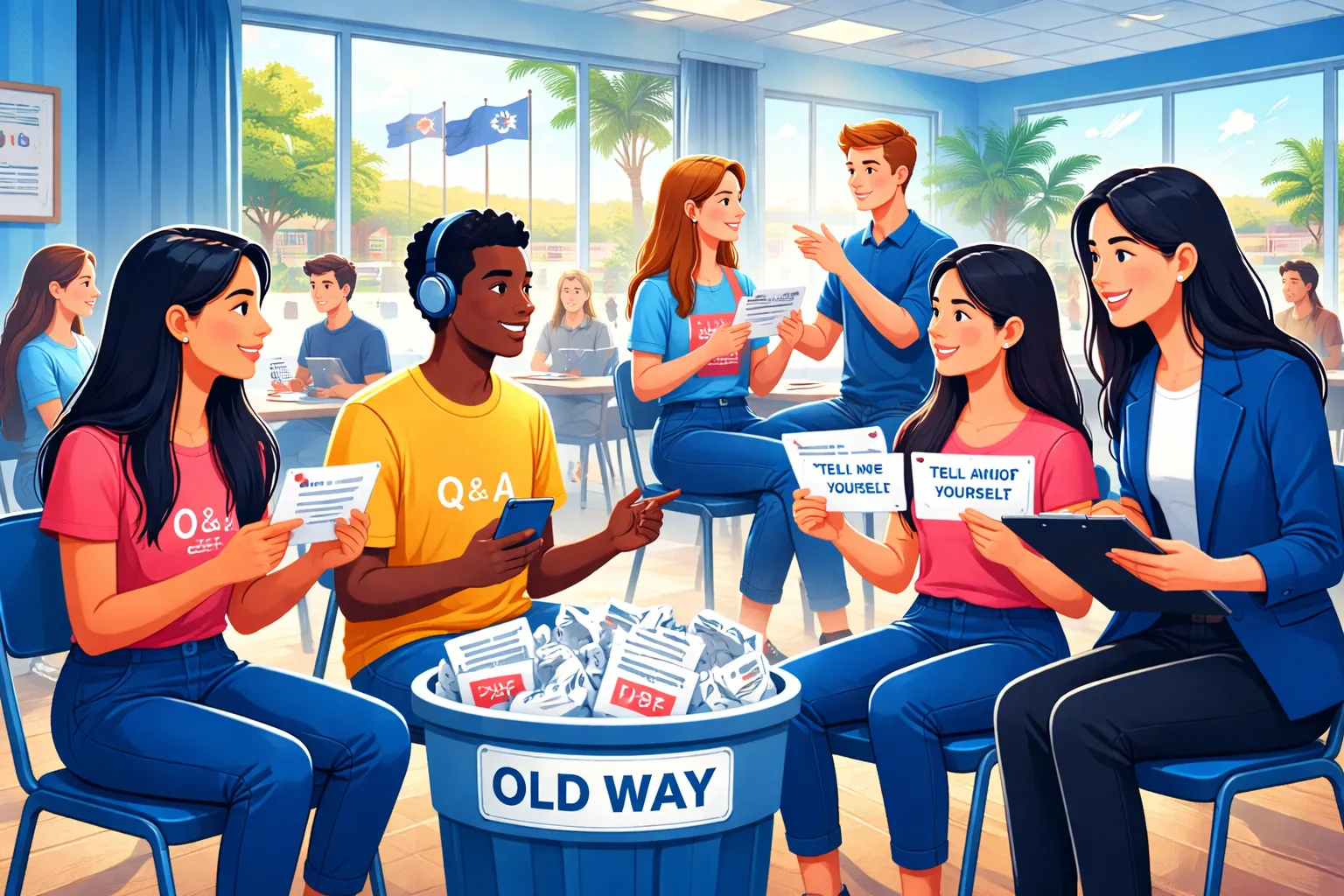
A police department teaching teenagers resume and interview skills made headlines this week, and the real takeaway isn’t “kids need help.” It’s that hiring is still weirdly allergic to evidence. We keep asking people for a PDF autobiography, then act surprised when interviews turn into vibes-based theatre. Let’s fix that—Australian-style, practical, fast, and slightly less absurd.
A news story about a police-led workshop taught dozens of teens the basics: how to put together a resume, how to show up in an interview, and how to communicate professionally. The specific organiser and location aren’t the point for Australia—the signal is.
The signal is that “life-valuable skills” (communication, preparation, confidence, reliability, basic workplace etiquette) are becoming the difference between getting screened in or screened out.
At the same time, Australian job ads keep reinforcing the same pattern: employers want proof you can do the work, collaborate, and communicate. Look at typical roles being promoted on LinkedIn in Australia right now—settlement roles, buying roles, business development, tax tech/business analyst roles, government consulting hiring pushes. Different industries, same subtext: you’re being assessed on how you work, not just what you’ve done.
And with ongoing talk in Australian media about job losses and uncertainty, the bar for clarity is rising. When the market feels shaky, recruiters tighten shortlists and hiring managers default to “safe” candidates. The easiest way to look safe is to look prepared.
So here’s the play: stop treating resumes and interviews as separate events. Build one simple system that generates receipts—proof of skills—then reuse it everywhere.
This is a seven-day sprint you can repeat every week until you land the role (or fill it).
Start with one rule: every claim needs evidence.
Day 1: Pick your target role and steal its language (legally)
Job seekers: choose 1–2 roles you’ll apply for this week in Australia. Copy the key requirements into a doc.
Recruiters: pick your hardest-to-fill role. Copy the “must have” and “nice to have” into a scorecard.
Then translate requirements into observable behaviours.
Examples:
- “Strong stakeholder management” becomes “ran weekly updates with X group; resolved Y conflict; got Z decision.”
- “Attention to detail” becomes “caught and corrected A before it became B; maintained C with 99% accuracy.”
Day 2: Build a proof bank (10 bullets, no fluff)
Create 10 proof bullets using this format:
Action + Tool/Method + Outcome + Proof
- Action: what you did
- Tool/Method: how you did it
- Outcome: what changed
- Proof: number, artefact, or reference
If you have no numbers, use counts, time saved, error reduced, volume handled, or “before/after.” If you truly have none, create proof via a mini project this week.
Day 3: Rewrite your resume into a skills-first snapshot
Yes, you may still need a resume for some ATS systems. But make it a snapshot, not a novel.
Structure:
- Headline: target role + specialty
- 3-line summary: what you do + who you do it for + strongest proof
- Skills: only those you can prove
- Experience: 3–5 bullets per role, each a proof bullet
Kill:
- “References available upon request” (everyone knows)
- 12-dot-point duty lists
- “Objective: to obtain a challenging position…” (we beg you)
Day 4: Prepare a 90-second intro that doesn’t sound like a hostage video
Use this script:
“I’m a [role/discipline] who’s strongest in [skill 1] and [skill 2]. Recently I [proof story]. I’m looking for [target role] where I can [value].”
Record it on your phone. Listen once. Fix the part where you ramble.
Day 5: Build your interview answer library (5 stories)
Pick five stories and map them to common Australian interview prompts:
- A time you handled a difficult stakeholder
- A time you improved a process
- A time you made a mistake and fixed it
- A time you worked under pressure
- A time you learned something fast
Use STAR, but don’t worship it. The only sacred part is the result and what you learned.
Day 6: Run a mock interview with a scoring sheet
Job seekers: ask a friend, mentor, or former colleague to interview you for 20 minutes.
Recruiters: run structured interviews with consistent questions and a rubric. If you’re not scoring consistently, you’re not interviewing—you’re improvising.
Simple scoring categories (1–5):
- Clarity
- Evidence
- Role fit
- Communication
- Coachability
Day 7: Apply with a “micro-portfolio” message
Send a short application message that points to proof.
Job seeker application message template:
Subject: Application — [Role] — [Your Name]
Hi [Name],
I’m applying for the [Role] in [City/Remote]. I’m strongest in [skill] and [skill], and I’ve attached/linked proof:
- [Proof 1: outcome + artefact]
- [Proof 2: outcome + artefact]
- [Proof 3: outcome + artefact]
If helpful, I can walk you through these in 10 minutes.
Thanks,
[Name] | [Phone] | [Link]
Recruiter outreach template:
Subject: Quick check — evidence-first shortlist for [Role]
Hi [Hiring Manager],
To reduce interview churn, I’m shortlisting candidates who can show evidence for:
- [Skill 1] (examples: …)
- [Skill 2]
- [Skill 3]
I’ll send profiles with a one-page proof summary + 2 artefacts each.
Regards,
[Name]
Examples
Here are concrete examples tailored to common Australian hiring patterns.
Example 1: Early-career candidate with limited experience
Resume bullet (retail or hospitality experience):
- Reduced checkout queue time by reorganising peak-hour roles and pre-bagging top items; average wait dropped from ~6 minutes to ~3 minutes across Friday evenings (tracked over 4 weeks).
Interview answer (pressure):
- “We had a sudden rush and a staff member called in sick. I reassigned tasks, kept one person on customer communication, and used a simple triage rule: quick wins first, complex orders flagged. We got through the rush with zero complaints logged that night. I learned that calm instructions beat heroic solo efforts.”
Proof artefact ideas:
- A simple spreadsheet showing wait times
- A short supervisor reference note
- A one-page “peak-hour workflow” you wrote
Example 2: Recruiter hiring a Sydney-based operations role
Instead of “must have 3+ years,” try evidence prompts:
- “Describe the settlement workflow you’ve run end-to-end. What were the top three failure points and how did you prevent them?”
- “Show an example of a checklist you used to avoid errors.”
Candidate submission format:
- 6-line summary
- 5 proof bullets
- 2 artefacts (redacted)
Example 3: Candidate targeting business development in Australia
Resume bullet:
- Built a weekly pipeline rhythm (prospecting, follow-ups, proposal tracking) and lifted qualified meetings from 3/week to 7/week within 6 weeks; tracked in CRM and reported weekly.
Interview close script:
- “Based on what you’ve shared, the first 30 days should focus on pipeline hygiene and quick wins in [segment]. If I joined, what would make you say ‘this hire was a win’ by week four?”
Example 4: Candidate targeting analyst/tech-enabled roles
Proof bullet:
- Automated a recurring report using [tool] and reduced manual preparation time from 2 hours to 20 minutes; added validation checks that cut errors spotted by reviewers.
Artefact:
- A redacted dashboard screenshot
- A short write-up: problem → approach → result
Checklist
- I selected 1–2 target roles in Australia and copied the requirements into a doc
- I translated requirements into behaviours I can prove
- I wrote 10 proof bullets (Action + Method + Outcome + Proof)
- My resume is a snapshot: headline, 3-line summary, skills I can prove, proof bullets
- I recorded a 90-second intro and removed rambling
- I prepared 5 interview stories and matched them to common questions
- I did one mock interview and scored myself on clarity and evidence
- I created 2–3 artefacts (redacted) to support my claims
- I sent applications/outreach with proof links, not just “please see attached”
- I booked next week’s sprint (same steps, better proof)
FAQ
Do I still need a resume in Australia?
Often, yes—many employers and systems still ask for one. But treat it like a label on a product, not the product itself. The product is your evidence: outcomes, artefacts, and clear stories.
What if I’m a teen, student, or career changer with no “real” experience?
You have experience. You might not have a fancy job title. Use projects, volunteering, school leadership, sport, part-time work, or family responsibilities—then convert them into proof bullets and artefacts.
Recruiters: how do I assess “life-valuable skills” without bias?
Use structured questions, consistent rubrics, and evidence prompts. Score what you can observe: clarity, preparation, examples, learning ability. Avoid “culture fit” as a vague excuse for gut feel.
How many artefacts should I share?
Two or three is plenty. Redact sensitive details. The goal is to show how you think and what you delivered, not to leak an employer’s data.
What’s the fastest way to improve interview performance this week?
Record yourself answering three questions. Most people discover the problem in under five minutes: they don’t answer the question, they don’t show evidence, or they don’t land the result.
The future of hiring in Australia doesn’t need more polished PDFs. It needs clearer proof, faster matching, and less time wasted on guesswork. If you want to skip the resume circus and show what you can actually do, sign up free at wipperoz.com and have your virtual CV ready in 5 minutes.
If you're comparing resume formats, explore video resume builder in Australia.
Ready to create your Virtual CV?
Join the people who stopped sending PDF resumes and started being seen.