
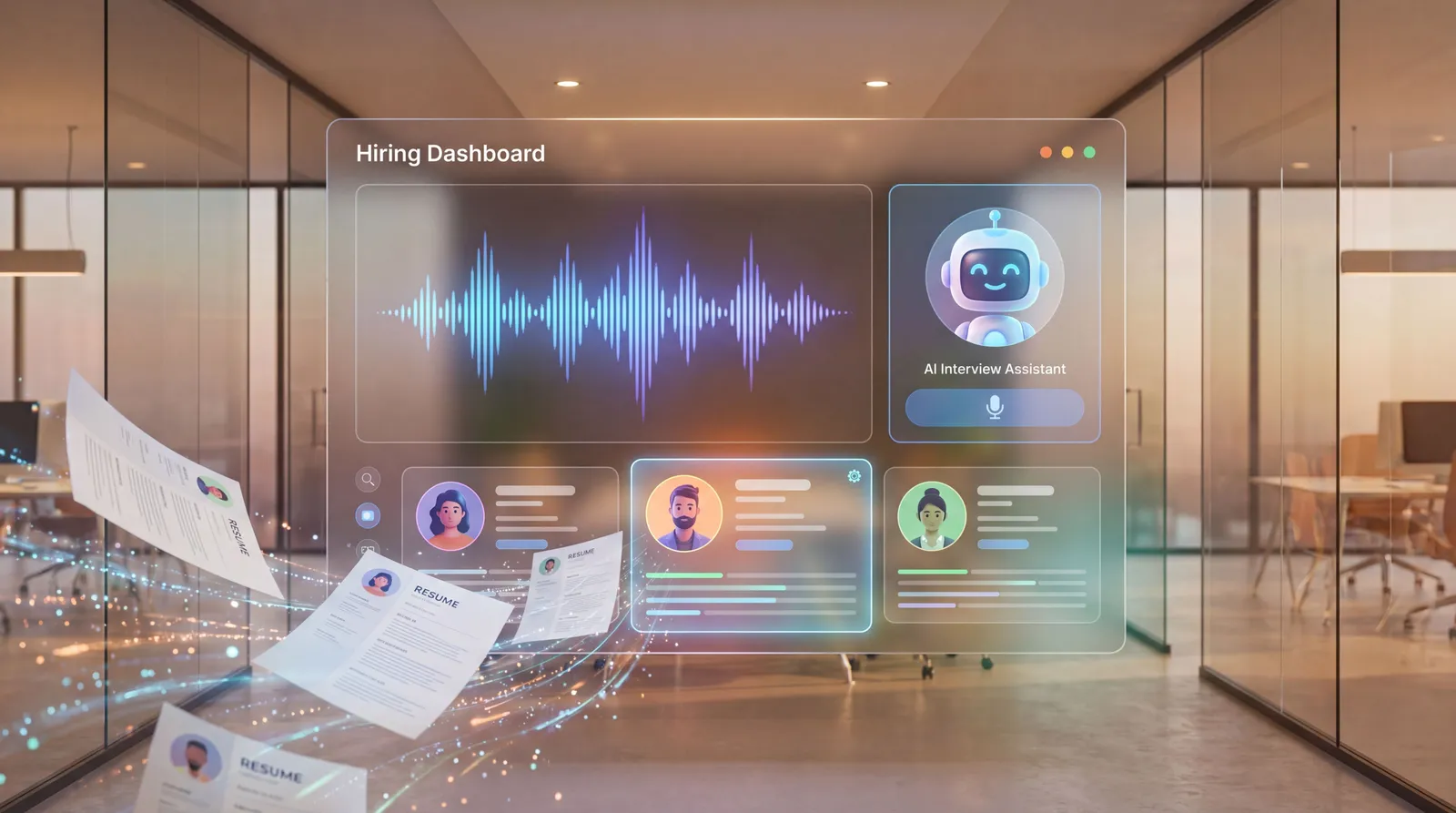
JobsUPI’s $250K Bet Says Voice AI Hiring Is Coming for the Resume Stack
JobsUPI’s pre-seed round is small, but the signal is loud: hiring is moving from static resumes to voice-led, AI-native workflows.

A $250K pre-seed round doesn’t usually shake the global hiring market. But JobsUPI’s raise is interesting because it points at something much bigger than the cheque size: the slow, awkward death of resume-first recruiting. And honestly, good riddance. The PDF resume has had a very long run for a document that mostly rewards formatting, keyword stuffing, and whoever found the nicest ats friendly cv template at 1 a.m.
According to Voice AI hiring platform JobsUPI secures $250K pre-seed round - People Matters - HR News, JobsUPI has secured $250,000 in pre-seed funding for its voice AI hiring platform. It’s early-stage, yes. Tiny compared with the mega-rounds that used to get sprayed across SaaS like glitter. But in 2026, early money is more selective. Investors are looking for workflows that remove friction, not just add another shiny dashboard.
That’s why this matters for founders, growth teams, product builders, and anyone watching Product Hunt-style product discovery. JobsUPI is not just another hiring product. It sits inside a broader pattern: tools that turn human input into structured, usable signal. Voice becomes data. Conversation becomes screening. Candidate intent becomes measurable. It’s messy, powerful, and slightly uncomfortable. Which is usually where useful product categories are born.
The product discovery angle: voice is becoming an interface, not a feature
Product Hunt has become a strange little weather station for what builders think the next interface will be. One week it’s AI agents. The next it’s vibe-coded software factories. Then content tools that turn prompts into visual assets, clips, workflows, microsites, or entire agencies if the landing page is feeling ambitious.
Look at the surrounding launch signals. Gas City 1.0: build your own software factory - Product Hunt points to founders wanting production systems, not isolated apps. Magic Studio by Once UI: Turn Once UI into a $10k agency - Product Hunt reflects the same thing in a different wrapper: package expertise into repeatable output. The product market is shifting from “help me do one task” to “build me a machine that keeps doing the task while I sleep.”
JobsUPI fits neatly into that machine-building mood. Hiring teams don’t just need another resume inbox. They need a way to collect better signal, faster, across large candidate pools. Voice AI can ask, listen, summarise, route, and score. Done well, it can reduce the brutal waiting game candidates hate and recruiters barely survive.
Done badly, of course, it becomes a robot bouncer at the door of your career. Nobody wants that. The line between efficiency and dehumanisation is thin enough to floss with.
Why hiring is ready for voice AI
Recruitment has always had an information problem. A resume says what someone claims they’ve done. An interview says how they perform under pressure, often with wildly inconsistent interviewer quality. A portfolio says more, but not every job has a neat portfolio. References are late-stage and biased. Assessments can help, but they add friction.
Voice AI offers a different layer: quick conversational screening that captures nuance beyond a document. How does a candidate explain a project? Can they describe trade-offs? Do they understand the role? Are they genuinely interested, or just panic-applying to 200 jobs with the same template?
That last bit matters. The rise of tools like resume genius and every ats friendly cv template under the sun has made applications easier to produce, but not always easier to trust. Candidates are gaming systems because the systems gamed them first. Recruiters respond with more filters. Candidates respond with more optimisation. Then everyone complains that hiring feels broken. Which it is.
Voice AI doesn’t automatically fix that. But it can rebalance the signal if designed with care. Instead of treating the resume as the sacred artefact, hiring teams can treat it as one input among many: structured profile, work samples, short voice responses, skills evidence, availability, location preferences, salary expectations, and actual motivation.
This is especially relevant across Australia, Canada, New Zealand, England, Ireland, Scotland, and the USA, where talent markets are increasingly hybrid, cross-border, and skills-led. Hiring teams don’t just compete locally anymore. A product manager in Dublin might be compared with one in Toronto. A customer success lead in Auckland might be applying to a UK-based remote company. The old stack wasn’t built for that reality.
Labour markets are uneven, and that makes screening harder
The timing is also important. Labour markets are not behaving in one neat global pattern. Some sectors are still hiring aggressively. Others are cautious. AI, cloud, cybersecurity, and specialised technology roles continue to pull demand in markets where companies are modernising their infrastructure and operations. AI, cybersecurity and cloud roles drive India’s IT hiring as GCCs fuel specialised talent demand: foundit - Fortune India is a useful reminder that specialised talent demand is still alive, even when broader markets feel patchy.
In the US, private payroll growth has also shown resilience at points, with Private payrolls rose by 109,000 in April, topping expectations, ADP says - CNBC reporting ADP’s April estimate above expectations. The signal for recruiters is not “everything is booming.” It’s more annoying than that. Demand is selective, skill-specific, and often urgent.
That creates a screening paradox. Companies may receive huge numbers of applications for general roles while struggling to find credible candidates for specialised ones. The better the job, the more noise it attracts. The more specialised the job, the more painful it is to screen properly.
Voice AI hiring platforms are being pulled into that gap.
The resume is becoming content, not proof
Here’s the uncomfortable truth: the resume has become a marketing asset. Sometimes a useful one. Often a theatrical one.
People optimise resumes like landing pages. They test keywords. They use resume genius-style builders. They hunt for an ats friendly cv template that can slip through automated filters. None of that is wrong. Candidates are responding rationally to a system that asks them to compress a messy human career into a two-page document and then punishes them for using the wrong phrase.
But once everyone learns the formatting game, the game stops revealing much.
This mirrors what happened in content. A few years ago, a polished video required gear, time, editing skill, maybe a nervous founder talking into a webcam for six hours. Now a growth team can use tools like flexclip, repurpose twitter videos, or turn a tweet to video in minutes. That’s brilliant for distribution. It’s also made polish less rare.
Hiring is heading the same way. A polished resume no longer means the candidate is the best fit. It may just mean they had the best tool. Again, not a moral failure. Just market evolution.
So the next layer of hiring tech has to ask: what signal is harder to fake, easier to compare, and respectful enough that candidates don’t feel like livestock moving through an automation chute?
Voice is one answer. Not the only one. But a serious one.
Writer POV
The smartest hiring products won’t “replace recruiters.” That framing is lazy and, frankly, a bit boring now. The smarter play is to replace the dead zones in hiring: the unread resume pile, the ghosted candidate, the repetitive phone screen, the vague rejection, the hiring manager who says “I’ll know it when I see it” and then vanishes for nine days.
JobsUPI’s raise is a market signal because it suggests founders are still finding wedge opportunities inside HR tech, even in a crowded category. But the winning wedge isn’t AI for AI’s sake. It’s better candidate signal with less theatre.
If your hiring product still treats the PDF resume as the centre of the universe, you’re not building the future. You’re polishing the fax machine.
What founders and product teams should watch next
For builders, JobsUPI raises a few strategic questions.
First, will voice AI hiring become a standalone category or disappear into broader applicant tracking systems? Standalone products can move faster and own the candidate experience. Larger HR suites can bundle features and win distribution. This is the classic startup headache: better product versus bigger pipeline.
Second, how will platforms handle fairness, consent, and explainability? Voice data is sensitive. Accents, speech patterns, background noise, disability considerations, and language fluency can all introduce risk if products are careless. A voice AI platform needs more than slick transcription and a cheerful bot voice. It needs governance, auditability, and clear boundaries on what is being assessed.
Third, what does the candidate actually get back? This is where most hiring tech falls flat. Companies get dashboards. Candidates get silence. If voice AI simply extracts more data from applicants without improving transparency, it will deserve the backlash it gets.
The best version of this category gives candidates a richer profile, faster feedback, and more control over how they present themselves. It lets employers screen at scale without pretending a resume keyword match equals ability. It also makes room for people who don’t look perfect on paper but can explain, build, sell, solve, and learn.
That matters in remote and hybrid labour markets. The The Rise of Remote Work: Effects on California’s Labor Market - Legislative Analyst’s Office (.gov) highlights how remote work has reshaped labour market dynamics in one major US state, and the pattern is familiar across other English-speaking markets too. Geography still matters, but it matters differently. Screening systems need to understand that.
The strategic backlink lesson for external writers
For external writers covering tools like JobsUPI, this is exactly the kind of story worth analysing. Not because every pre-seed funding announcement deserves a standing ovation. Most don’t. But because small product signals can reveal where markets are bending.
A portfolio-quality article shouldn’t just say “startup raised money.” That’s table stakes and usually dull. The better angle is: what behaviour is this product betting on? What pain is it trying to remove? What adjacent launches support the trend? What risks could kill adoption? And what should founders learn from it?
That’s how you turn a Product Hunt discovery or funding snippet into research-backed thought leadership. You connect JobsUPI to remote work, specialised talent demand, creator-tool style automation, and the collapse of resume-only trust. You show the reader the pattern behind the product.
This is also where strategic backlinks earn their place naturally. If you’re writing for a third-party publication, don’t wedge links in like a raccoon stuffing bread into a drainpipe. Link to useful context. Link to labour market research. Link to a platform when it genuinely extends the idea. For example, if the thesis is that static resumes are giving way to richer candidate profiles, a natural link to Wipperoz makes sense because it’s building around that exact shift.
What JobsUPI signals for the next hiring stack
JobsUPI’s $250K round is not proof that voice AI will dominate hiring. It is proof that investors and founders are still hunting for a better interface between people and opportunity.
The old hiring stack was built around documents, databases, and delayed conversations. The new one is being built around live signal: voice, video, structured profiles, work evidence, AI summaries, and candidate-owned data. Some of it will be brilliant. Some of it will be cursed. That’s technology. We get the spaceship and the spam folder.
But the direction is hard to ignore. Hiring is becoming more interactive, more automated, and more signal-hungry. The challenge is making it more human at the same time.
That’s the paradox worth building for.
And if you’re still asking candidates to upload a resume, manually retype the same resume into boxes, then wait three weeks for a generic rejection, maybe don’t call that a talent strategy. Call it what it is: administrative cosplay.
If you’re ready to move beyond the PDF circus, sign up for free and have your virtual CV ready in 5 minutes at discover Wipperoz.
If you're comparing resume formats, explore video resume builder in Australia.
Ready to create your Virtual CV?
Join the people who stopped sending PDF resumes and started being seen.