Insurance’s Junior Hiring Problem Isn’t AI. It’s the Office Mandate.
Junior insurance hiring is being blamed on AI, but the bigger issue may be rigid remote work rules and outdated hiring signals.

The insurance industry keeps pointing at AI like it’s the villain in the junior hiring story. Convenient. Dramatic. Slightly lazy. The harder truth is that many firms are struggling to attract early-career talent because their work policies still feel like they were laminated in 2017 and stored in a filing cabinet next to the fax machine.
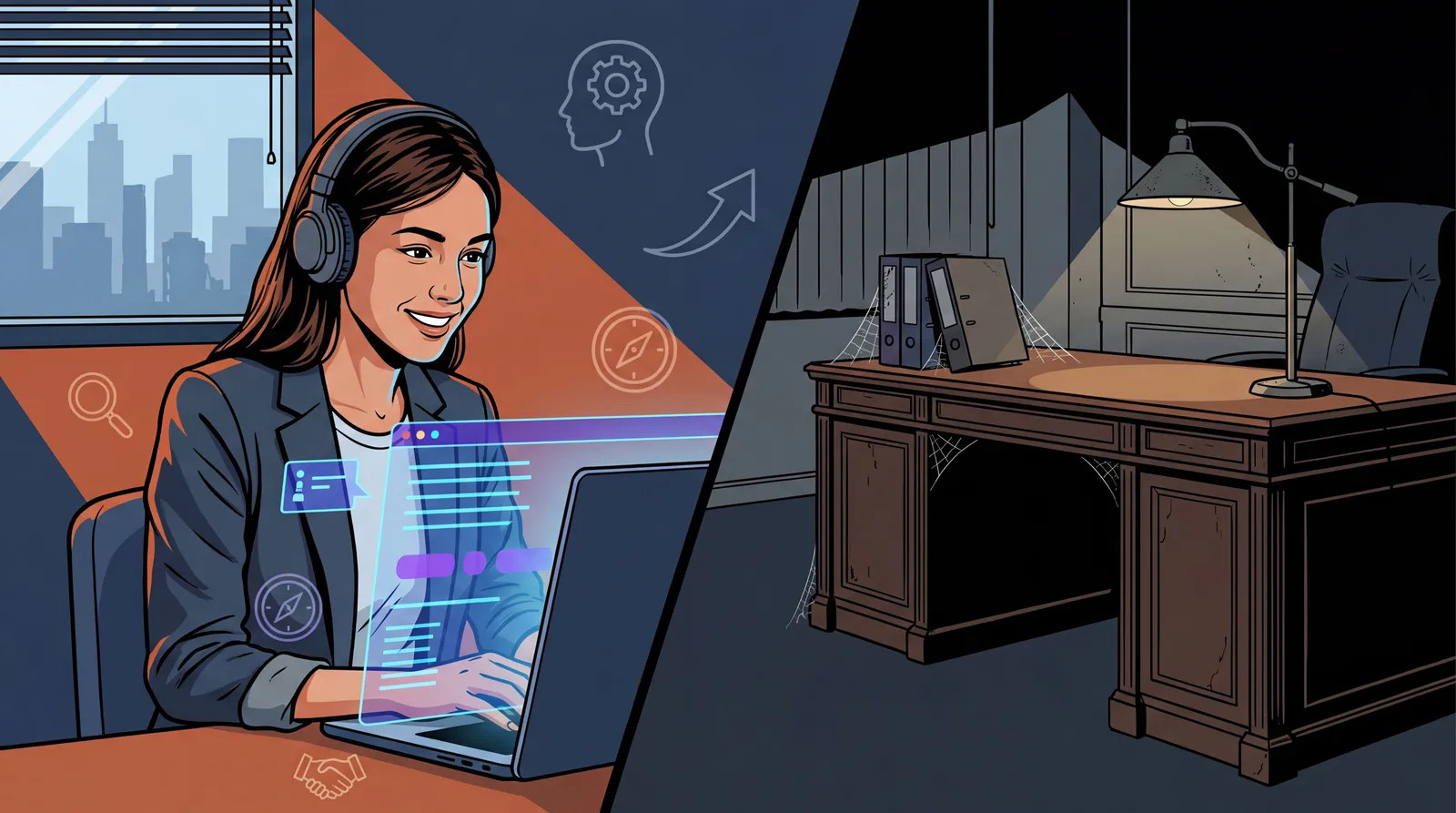
A recent hiring conversation surfaced through The insurance industry’s junior hiring problem isn’t about AI. It’s about your remote work policy - Insurance Business makes a point worth dragging into the wider talent debate: younger workers aren’t simply rejecting insurance because algorithms are eating entry-level jobs. They’re rejecting employers that ask them to commute into expensive cities for jobs that could clearly be done with a laptop, a headset, a secure workflow, and maybe one meeting that actually needed to be a meeting.
This isn’t just an insurance problem. It’s a signal for every founder, product builder, growth team, and hiring manager watching the market shift under their feet. AI is changing work, yes. But the real fracture line is trust. Do companies trust junior people to learn, contribute, and grow outside the office? Or do they only trust them when they’re visible under fluorescent lights?
That question matters more than a hundred recycled interview questions.
Product discovery angle: why Tokenwise matters here
On Product Hunt, Tokenwise: A smart LLM proxy that shows where you’re overpaying - Product Hunt landed with a very current promise: help teams understand where they’re spending too much on large language model usage. That sounds like a narrow infrastructure tool at first glance. Underneath, though, it points to something much bigger.
Companies are now instrumenting AI work. They’re measuring token usage, routing models, managing cost, and treating AI as a serious operational layer. In other words, firms are getting extremely sophisticated about machine productivity while staying oddly primitive about human productivity.
That’s the absurd bit.
A company may know exactly how many cents it spent on an LLM request, but still have no clue whether its junior underwriters, claims analysts, customer success reps, or operations trainees are being blocked by a bad onboarding process, a rigid office policy, or screening criteria that reward polish over potential.
The product signal from Tokenwise is not just “AI cost control is hot.” It’s that modern businesses are learning to optimize invisible systems. Hiring needs the same treatment. Not more résumé PDFs. Not more keyword bingo. Actual visibility into capability, motivation, proof of work, learning velocity, and fit for the way teams now operate.
Remote work policy is now an employer brand
For years, companies treated remote work as a perk. Nice to have. A sweetener. Something tucked into the benefits section after dental and before “casual Fridays,” which somehow still exists.
That era is gone.
For junior candidates, remote and hybrid work can shape whether a role is even viable. Rent is high in Sydney, Toronto, London, Dublin, Auckland, Edinburgh, New York, and most other places where big employers like to cluster. Transport costs aren’t imaginary. Neither is the time lost commuting. If a graduate or career changer can earn the same or slightly less in a more flexible sector, insurance has to explain why being physically present is worth it.
Sometimes it is. Apprenticeship, mentoring, shadowing, compliance training, client exposure, and cultural learning can benefit from in-person time. Pretending otherwise is silly.
But there’s a Grand Canyon-sized difference between intentional office days and vague mandates. “Come in because collaboration” is not a policy. It’s a shrug wearing a blazer.
The smartest firms are designing junior work like a product. They ask: what needs to happen in person, what can happen asynchronously, what needs coaching, what can be automated, and what should never have been a meeting in the first place?
That design mindset is what insurance needs if it wants to compete with tech, fintech, climate analytics, cybersecurity, and the endless universe of startups that know how to sell flexibility as part of the job, not a side dish.
The talent market is messy, not dead
It’s tempting to look at layoffs, hiring freezes, and AI disruption and conclude that junior hiring is simply collapsing. That’s too neat.
The broader market is mixed. Reports like Top Companies that Announced Major Layoffs & Hiring Freezes-2025 - 26 - Intellizence show how some employers continue to cut costs or pause expansion. At the same time, technical and AI-related hiring is still happening in pockets, with stories such as OpenAI wants you to have your personal AI robot, starts hiring for robotics team - India Today showing that frontier companies are still building teams where they see strategic upside.
That matters for insurance. If an industry frames junior hiring as a casualty of AI, it risks missing the more practical issue: other sectors are simply making a better offer.
Not always more money. Often more momentum.
A young candidate comparing roles may see insurance as stable but slow. They may see tech as volatile but skill-building. They may see energy, property, or climate roles as mission-heavy. Even a niche career path like domestic energy assessor can sound more tangible and future-facing than a generic junior analyst role with a three-day office mandate and a PDF application process from another geological era.
And yes, some people still search for things like “temp services near me” because they want work now, not after six rounds, two personality tests, a cover letter, and a mysterious silence lasting 23 business days. That search behaviour is a flashing red sign for employers: speed matters.
The interview process is part of the problem
Let’s talk about interview questions. The classic early-career process is often a theatre production where everyone pretends the candidate has deep professional wisdom and the employer has a perfectly objective evaluation model.
Neither is usually true.
Too many junior interviews still lean on vague prompts: “Tell me about a time you handled conflict.” “Where do you see yourself in five years?” “Why insurance?” Fine questions in moderation. But when they become the main signal, confident candidates win and capable candidates get filtered out.
The better interview question and assessment design for junior insurance roles should focus on learning behaviour. Give candidates a realistic scenario. Ask them to explain a trade-off. Show them a short claims example, a customer email, or a risk profile and ask what they’d clarify before acting. You’re not looking for perfection. You’re looking for curiosity, structure, communication, and coachability.
This is where insurance can borrow from product teams. Product builders don’t only ask, “Have you used this tool before?” They ask how someone thinks, prioritizes, tests assumptions, and responds when the first answer is wrong.
Junior hiring should do the same.
And please, stop treating degrees as magical truth machines. A candidate from a major university, a bootcamp, a community college, canyon university, an apprenticeship pathway, or a completely non-linear background may all have relevant potential. The issue is whether your hiring system can see it.
A PDF résumé usually can’t. It’s a paper passport for a digital labour market. Charming, maybe. Useful, barely.
Writer POV
The remote work debate has become weirdly moralistic. Some leaders talk about office attendance as if sitting near a printer builds character.
Here’s the sharper view: if your junior talent model only works when people are physically watched, your management system is the weak point. Not the graduate. Not AI. Not “Gen Z.” Your system.
Insurance has a huge opportunity because the work is meaningful. Risk is everywhere now: cyber attacks, climate events, supply chain shocks, health uncertainty, property volatility. This should be one of the most interesting industries for ambitious young people.
But you can’t sell future-facing work through backward-facing rules.
What founders and growth teams should take from this
Even if you’re nowhere near insurance, this story is useful. It shows how talent markets punish contradiction.
You can’t market yourself as innovative while forcing candidates through clunky hiring steps. You can’t talk about AI transformation while refusing to redesign onboarding. You can’t say you trust young people with complex work but not trust them to work from home two days a week.
The same lesson applies to HR tech products, recruitment marketplaces, staffing platforms, and internal talent teams. The winners will reduce friction. They’ll show proof faster. They’ll help candidates demonstrate ability beyond static documents. They’ll give hiring teams better signals without turning the process into a surveillance circus.
This is where the Product Hunt world and the hiring world are starting to overlap. Tools like Tokenwise show how teams want clarity in AI operations. Hiring needs clarity too: clearer candidate profiles, clearer skills evidence, clearer expectations, clearer feedback loops.
Not a bigger pile of PDFs.
So what should insurance employers actually do?
Start by splitting the junior role into learning moments and delivery moments. Learning moments may benefit from in-person collaboration: shadowing a senior broker, sitting in on a complex client discussion, joining a claims review, or getting feedback after a tricky customer interaction. Delivery moments may not need an office at all.
Then make the policy explicit. Don’t say “hybrid” if it means “whatever the loudest manager prefers.” Tell candidates how many days, why those days matter, what support they’ll get remotely, and how performance will be judged.
Next, rewrite the assessment process. Use practical scenarios. Reduce performative interview questions. Add structured scoring. Train interviewers to look for potential, not just polish. If you’re using AI tools in screening, audit them carefully and keep humans accountable for the final judgement.
Finally, speed up. Early-career candidates are not going to wait forever while your internal approval chain slowly migrates across five inboxes. The best people have options, including contract work, freelance projects, startup roles, and yes, those “temp services near me” pathways that may offer quicker entry into paid experience.
Junior hiring isn’t charity. It’s market-making. If you don’t build the next generation, you eventually run out of people who understand the business deeply enough to lead it.
The market signal is bigger than insurance
The easy headline is that AI is coming for entry-level jobs. The better headline is that entry-level work is being renegotiated.
Candidates want flexibility, speed, relevance, and a way to prove themselves beyond old credentials. Employers want capability, reliability, adaptability, and lower hiring risk. The old résumé-first system does a poor job serving either side.
That’s why this conversation belongs in a Wipperoz lens. The future of hiring won’t be a prettier PDF. It’ll be a richer, living picture of what someone can do, how they communicate, what they’ve built, and where they’re going next.
Insurance can fix its junior hiring problem. So can plenty of other industries. But first they’ll need to stop hiding behind AI and look directly at the work design, the hiring signals, and the policies that candidates are already judging them on.
If you’re rethinking how talent should show up in a world where the PDF résumé feels increasingly absurd, now’s a good time to discover Wipperoz.
Create your virtual CV, show more than a flat document ever could, and sign up free at Wipperoz so your profile is ready in 5 minutes. Because honestly, hiring has waited long enough.
If you're comparing resume formats, explore video resume builder in Australia.
Ready to create your Virtual CV?
Join the people who stopped sending PDF resumes and started being seen.