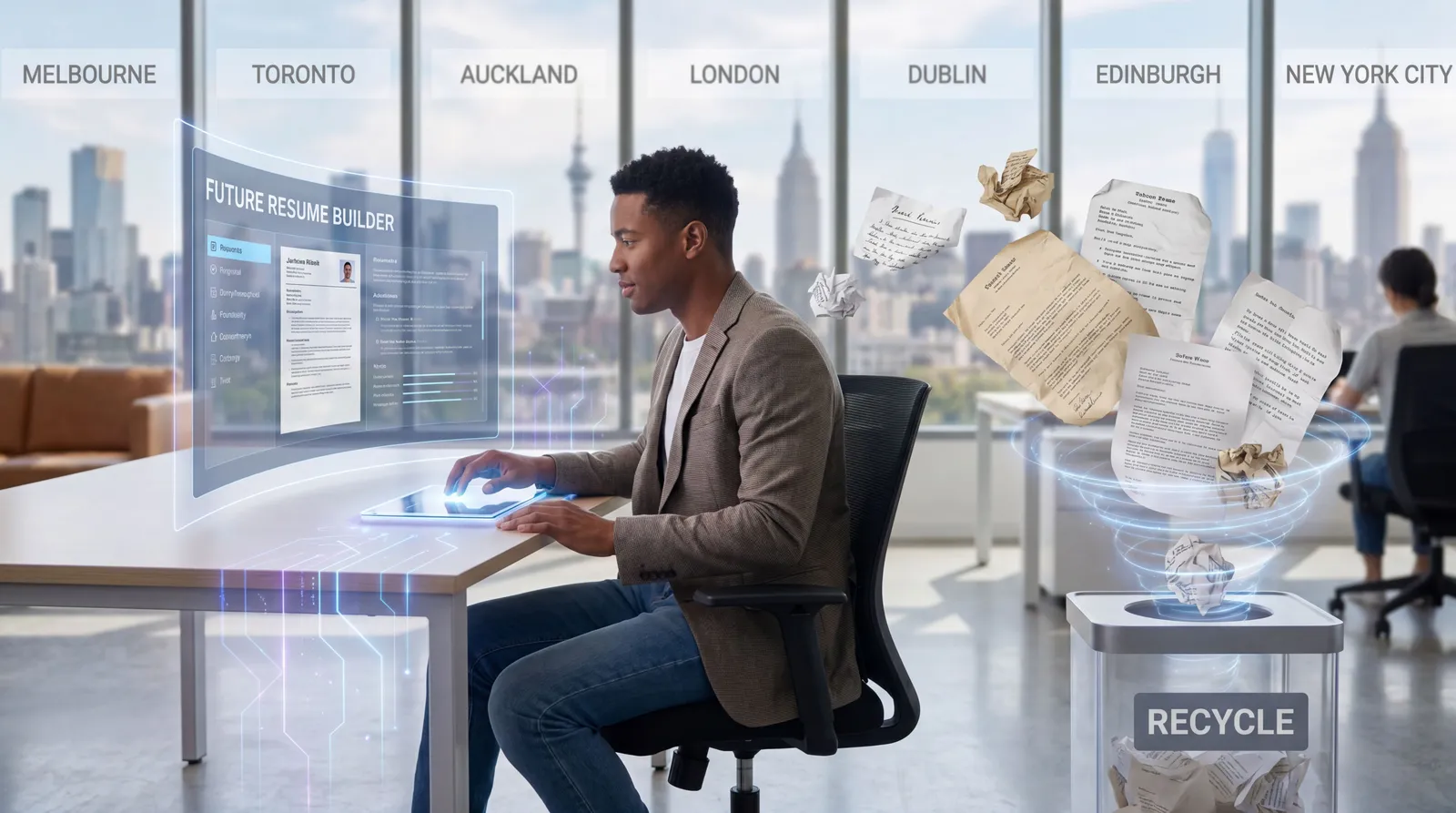
Free Resume Builders in 2026: What Job Seekers Should Actually Know
Free resume builders can help, but they’re not magic. Here’s what job seekers and recruiters should really watch for in 2026.

Let’s say the quiet part out loud: asking people to compress their working life into a static PDF is a bit ridiculous. It made some sense when hiring moved by email attachment and luck. In 2026, it feels like bringing a fax machine to a video call. Still, the resume hasn’t vanished. It has just become a weird little passport document in a hiring system that now expects speed, clarity, keywords, proof of skills, and increasingly, context.
That’s why free resume builders are everywhere. They promise polished layouts, ATS-friendly formatting, a quick cover letter, and sometimes even prewritten bullet points. Handy? Yes. Magical? Not even close.
Recent coverage like Free Resume Builders in 2026: What Job Seekers Should Know - Bergen Record and AI Resume Builder for Faster, Smarter Job Searches in 2026 - The Post-Crescent points to the same thing: job seekers are leaning on AI-assisted tools to move faster, and recruiters are seeing more machine-polished applications than ever. No surprise there. When labour markets stay competitive and employers keep filtering at scale, convenience wins.
But convenience can also create a sea of sameness.
What free resume builders are good at
A good free resume builder solves the boring stuff. Formatting. Spacing. consistent headings. Exporting to PDF. Giving people a structure so they don’t stare at a blank page for 90 minutes and then type “hardworking team player” like it’s still 2009.
For job seekers across Australia, Canada, New Zealand, England, Ireland, Scotland and the USA, that matters. A builder can help you:
- create clean, readable resume templates fast
- organise experience in a way recruiters can scan quickly
- produce a basic cover letter without starting from zero
- tailor wording around a job title or skill area
- avoid design choices that break applicant tracking systems
That last point matters more than people think. Recruiters don’t reject candidates because a serif font offended them. They reject confusion. If your layout hides job titles, splits dates awkwardly, or buries skills under decorative fluff, you’re making the screening process harder than it needs to be.
Free tools can reduce that mess. That’s the good news.
Where free tools start to fall apart
The problem isn’t the builder. It’s the illusion.
A resume builder can generate a document. It cannot generate a credible career story unless you give it one. And it definitely can’t tell whether your “strategic leadership” bullet point sounds impressive or just inflated.
This is where a lot of candidates get trapped. They use the same resume templates as thousands of other people, plug in generic summaries, add a cover letter template, maybe borrow from popular cover letter examples, and hit apply. The result looks polished but says almost nothing.
Recruiters notice. Fast.
The modern hiring stack is weirdly split. On one side, systems want structure and keywords. On the other, humans still want evidence, judgment and relevance. So yes, your resume builder should help your file get parsed correctly. But if the content feels mass-produced, the application still dies a very human death.
The real 2026 question isn’t “Is it free?”
It’s “Does it help me show fit?”
That’s the only question that really matters.
A free tool is useful if it helps you do three things well:
Make your experience specific
Specific beats polished every time. “Managed projects” is fog. “Led a cross-functional rollout delivered two weeks early” is something a recruiter can actually hold onto.
The best resume builder won’t save vague writing. If you use AI to draft bullets, treat the first version as compost, not final copy. Turn generic claims into proof. Add numbers where they’re real. Name the tools, outcomes, team size, scope or customer impact.
Match the language of the role without becoming a keyword soup machine
Yes, keywords matter. That’s not a conspiracy theory. Employers across these markets still use systems and workflows that depend on consistent language. Public labour and occupation resources like the Occupational Outlook Handbook and Jobs and Skills Atlas make that obvious enough: roles are described through recurring skills, tasks and capabilities.
But stuffing every possible term into your resume is a terrible strategy. It reads like panic. Better approach: mirror the language of the role where it truthfully matches your background. If a posting asks for stakeholder management, forecasting, SQL, patient care, site supervision or policy analysis, use those terms where they genuinely apply.
That same rule applies to a cover letter. The strongest cover letter examples don’t sound like legal disclaimers. They sound like a capable person connecting their experience to a real business need.
Stay readable for both humans and systems
Simple formatting still wins. Clear section headings. Reverse chronological order unless there’s a very good reason not to. Bullet points that begin with action and end with result. No text boxes if they break parsing. No graphic rating bars for “communication: 92%”. No one knows what that means, including the person who made it.
If you’re a recruiter, this matters too. Candidates are being trained by the internet to optimise for software. If your application process is clunky, vague or overloaded with duplicate steps, you’ll get lower-quality responses and more AI-generated filler. That’s not because people are lazy. It’s because the process invites it.
The cover letter isn’t dead, it’s just become less theatrical
A lot of applicants still ask whether they need a cover letter. Honest answer: sometimes yes, sometimes no, often maybe.
If the application asks for one, do it. If the role is competitive, communication-heavy, or involves a career shift, it can help. If you’ve got a strong referral and a very direct fit, it may matter less.
But the old formula is fading. Recruiters don’t need four paragraphs of Victorian enthusiasm about how thrilled you are to apply. They need a sharp explanation of why this role, why you, and what evidence backs that up.
A cover letter template is useful for structure. It is not a personality transplant. And most cover letter examples online are far too long.
A good modern cover letter usually does four things:
- names the role clearly
- shows understanding of what the employer likely needs
- proves relevant experience with one or two concrete examples
- makes the next step easy
That’s it. Shorter is usually better.
For recruiters, the bigger issue is upstream
Here’s the slightly absurd part of all this: hiring teams complain about generic applications while still asking people to submit static documents into outdated workflows. Then everyone acts shocked when candidates use automation.
Of course they do.
When application volume rises and time drops, people reach for tools. The answer isn’t to pretend resume builders are the problem. The answer is to design better hiring signals. Better screening questions. Better skill evidence. Better candidate profiles. Fewer pointless hoops.
That’s also why the future probably isn’t “resume versus no resume.” It’s a layered profile: verified experience, skill signals, work preferences, portfolio evidence, and a concise summary that can travel across systems without losing meaning.
The PDF won’t disappear overnight. It’s too embedded. But it’s clearly losing its throne.
What job seekers should do now
Use the free tools. Seriously. Just don’t confuse speed with quality.
Pick a clean resume builder. Use resume templates that prioritise clarity over decoration. Draft your cover letter with help if you want. Review a few cover letter examples to understand structure. Then stop copying the internet and make the application sound like you.
Before you send anything, ask:
- would a recruiter understand my value in 15 seconds?
- are my bullet points specific enough to be believable?
- does my cover letter say anything beyond “I am excited to apply”?
- have I tailored this for the role, or just cosmetically edited it?
- if this gets parsed by a system, will the important stuff survive?
That’s the real standard in 2026.
And if we’re being honest, it should’ve been the standard years ago.
If you’re tired of squeezing your career into a lifeless document, there’s a better way to start. Sign up free at Wipperoz and have your virtual CV ready in 5 minutes. It’s faster, smarter, and a lot more useful than pretending a static PDF is the final form of professional identity.
Related pages: Best AI Cover Letter Generators in 2026.
If you're comparing resume formats, explore video resume builder in Australia.
Ready to create your Virtual CV?
Join the people who stopped sending PDF resumes and started being seen.