Deeside’s future of work gets smaller, smarter, less obsessed
Deeside’s work model is shifting fast: more hybrid routines, stronger local hubs, and a hiring market that values flexibility over office theatre.
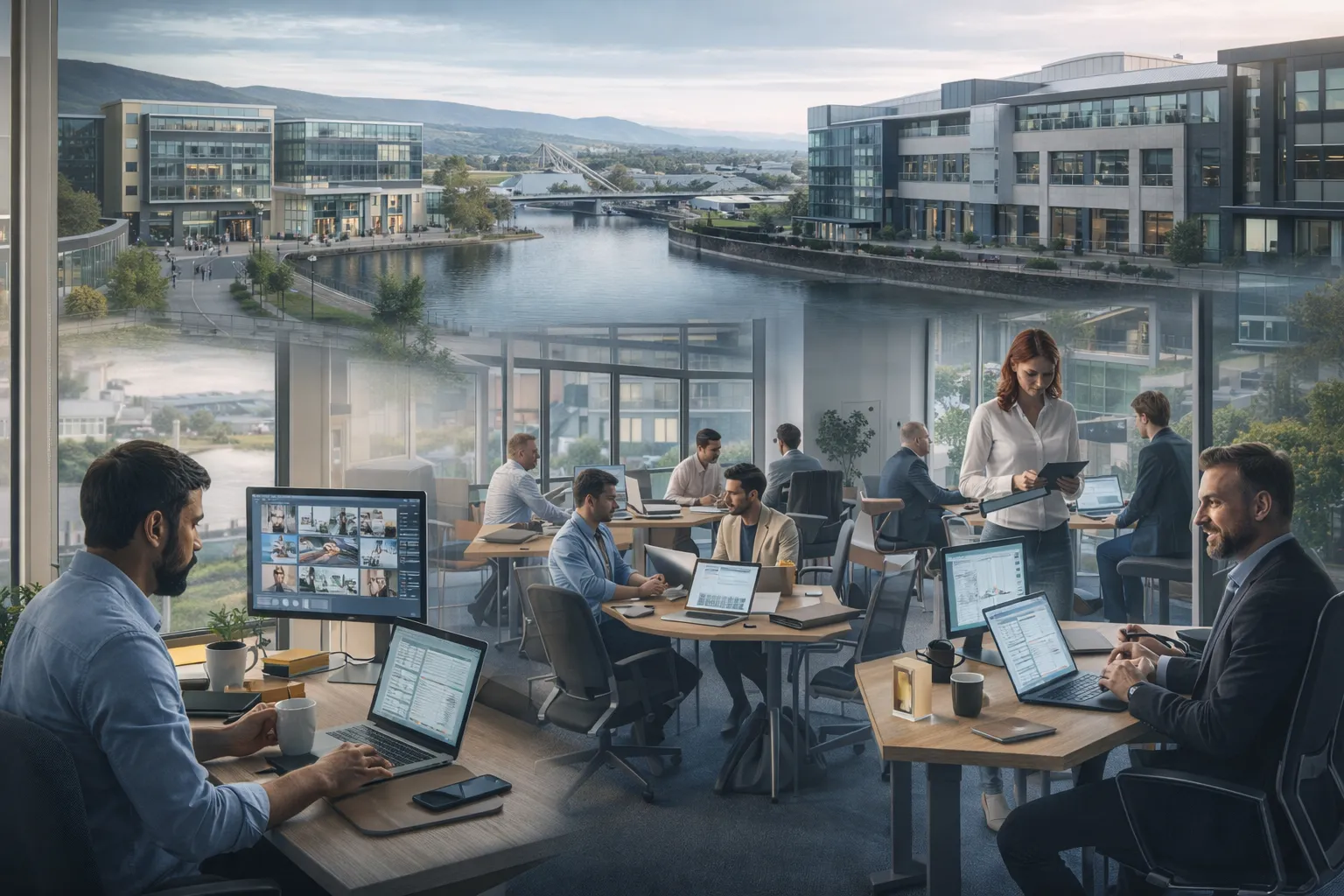
The future of work in Deeside won’t be decided by who can drag people back to a desk five days a week. It’ll be shaped by something far more practical: where people can do their best work, how often they need to commute, and whether employers are willing to stop confusing presence with productivity.
That shift is already visible. The conversation around Deeside is no longer just about traditional industrial strength or local employment resilience. It’s about a more layered model of work: remote roles that open access beyond immediate geography, local hubs that give people structure without the full commute, and hybrid setups that are becoming less of a perk and more of a baseline expectation.
The Deeside.com reporting points to exactly that tension. Work is changing, but not in one neat direction. Some employers still want office time. Workers still want flexibility. And the middle ground is getting more sophisticated than the old “three days in, two days out” formula everyone pretended was a strategy.
What makes Deeside especially interesting is that it reflects a wider pattern across England, Scotland, Ireland, Canada, Australia, New Zealand and the USA: local labour markets are being reshaped by national and global work habits. A role might be filled by someone who lives 15 minutes away, works mainly from home, and drops into a nearby hub twice a week instead of travelling to a central office every day. That’s not a fringe arrangement anymore. That’s the new normal trying to formalise itself.
Why remote work still matters, even after the backlash
There’s been a lot of noise lately about the “return to office”. Some of it is real. Some of it is executive nostalgia dressed up as culture. But the data backdrop still suggests labour markets remain more flexible than the loudest headlines imply.
In the US, new jobless claims recently ticked up to 210,000, but remained at historically healthy levels. That matters because it signals a labour market that is softening in places without collapsing. When labour markets stay reasonably resilient, workers usually keep pushing for better conditions, and flexibility stays high on that list.
At the same time, Wall Street recession odds have reportedly climbed as economists look for cracks under the surface of the economy. That combination is important. Employers may become more cautious on headcount, but candidates become more selective about risk. In that environment, remote and hybrid options can act like a stabiliser. They widen talent pools for employers and reduce friction for workers.
For Deeside, that means remote work isn’t just about convenience. It’s about competitiveness. If local employers insist on rigid attendance while comparable roles elsewhere offer flexibility, talent won’t politely accept the worse deal just because the office has decent parking.
Local hubs are the underrated middle ground
This is where the story gets more interesting.
Remote work was never going to mean everyone happily working forever from a kitchen table with patchy Wi-Fi and a dog barking through meetings. People need options. Not always headquarters. Not always home. Something in between.
That’s where local hubs come in.
For towns and regional employment zones like Deeside, local hubs can solve several problems at once. They shorten commutes, support concentration, create social contact, and give employers a physical touchpoint without forcing every worker into a central office. They also keep more daytime spending local, which matters for surrounding businesses.
There’s a practical logic to this. A worker may not want to commute into a larger city five days a week, but they may be perfectly willing to use a nearby workspace two or three times a week. For employers, that setup can support collaboration without paying for oversized office footprints built for a pre-2020 world.
And honestly, this is the part many organisations missed. The future of work was never a binary choice between “everyone back in” and “everyone stay home”. It was always going to be a network: home, hub, client site, smaller office, occasional team gathering. Deeside is well placed to benefit from that model if local infrastructure and employer thinking keep up.
Hybrid is maturing, and that changes hiring
Hybrid work is also becoming more selective. Early on, plenty of companies used the term loosely. It often meant “we still want you in most of the time, but we know the word flexible tests well in job ads.” Candidates are getting better at spotting that.
Now hybrid is maturing into something more measurable. Recruiters and job seekers alike are asking sharper questions:
- How many days on site, really?
- Are those days fixed or flexible?
- Is location tied to collaboration needs or managerial habit?
- Can someone progress in the role without being physically visible all the time?
Those questions matter in Deeside because hybrid hiring only works when expectations are clear. Vague flexibility is basically a workplace catfish.
This matters even more as technology keeps changing role design. Recent UK reporting on AI and job displacement adds another layer to the discussion. While estimates and methodologies vary, the broad signal is clear enough: some tasks are being automated, some roles are being reshaped, and hiring is increasingly focused on adaptability rather than static job descriptions.
That doesn’t mean work is disappearing in one dramatic sweep. It means the value of being physically present for routine tasks may keep falling, while the value of judgement, communication, problem-solving and technical fluency keeps rising. In hybrid environments, those human skills become more visible than time spent sitting under fluorescent lights.
What job seekers in Deeside should do now
If you’re looking for work in or around Deeside, the first thing to understand is this: flexibility is part of the role now, even when it isn’t advertised well.
So ask direct questions. Don’t wait until final interview stages to find out the “hybrid” role is actually four mandated office days and one day at home if the manager is feeling generous.
You should also think beyond job titles. Search by work style, team setup and skills adjacency. A remote-friendly operations role, customer success role, project support role or digital admin role may be more accessible than a narrow search built around one exact title.
It’s also worth positioning yourself for hybrid credibility. Employers want people who can work independently, communicate clearly, manage time well and stay effective without constant supervision. If your CV or profile only lists duties, you’re underselling yourself. Show outcomes. Show tools. Show how you work, not just where you worked.
And yes, local matters too. If Deeside develops stronger hub-based working patterns, employers may increasingly value candidates who can combine regional knowledge with flexible availability. That’s a useful edge.
What recruiters and employers should stop getting wrong
Let’s be blunt: plenty of employers still treat flexibility like a concession instead of a design principle. That’s a mistake.
If the role can be partly remote, say so clearly. If a local hub model is possible, build it intentionally. If office time is genuinely important, explain why. Adults can handle the truth. What they won’t tolerate for much longer is vague policy language hiding old-school control.
Recruiters in particular need to get more precise. The labour market is still giving mixed signals. In the US, hiring remains relatively healthy by historical standards, but caution is growing. Indeed’s recent labour market update also highlighted ongoing workforce shifts, including changes in participation and representation. In uncertain conditions, the employers who communicate clearly tend to win better trust.
That applies in Deeside too. Candidates want specifics. They want to know whether flexibility is real, whether progression is fair in hybrid teams, and whether the company has thought through collaboration beyond “we like people together”.
The organisations that get this right will probably hire faster and retain better. The ones that don’t will keep wondering why shortlisted candidates go cold after hearing the attendance policy.
The bigger signal from Deeside
What’s happening in Deeside isn’t a quirky local story. It’s a signal.
The future of work in places like this looks less centralised, less performative and more distributed. Not fully remote for everyone. Not office-first by default. Something more useful than either extreme.
A strong local economy used to be judged partly by how many people travelled into a workplace every morning. That metric is getting old. A better question now is whether people can access good work without unnecessary friction, whether employers can reach the right talent, and whether local infrastructure supports flexible, productive routines.
That’s the real shift. Work is becoming less about where the building sits and more about how the system functions.
For job seekers, that opens up more pathways. For recruiters, it demands clearer thinking. For Deeside, it could mean a more resilient and modern employment model if businesses lean into it instead of resisting it.
The PDF CV, by the way, is still doing its best impression of relevance while the world moves on around it. If you want to show employers how you actually work, not just where you’ve been, sign up free at https://wipperoz.com and have your virtual CV ready in 5 minutes. Smarter hiring starts with being easier to understand.
If you're comparing resume formats, explore video resume builder in Australia.
Ready to create your Virtual CV?
Join the people who stopped sending PDF resumes and started being seen.